
FedEx One Rate’s April Surprise: A 6.9% Increase Hidden in a Holiday Weekend Email
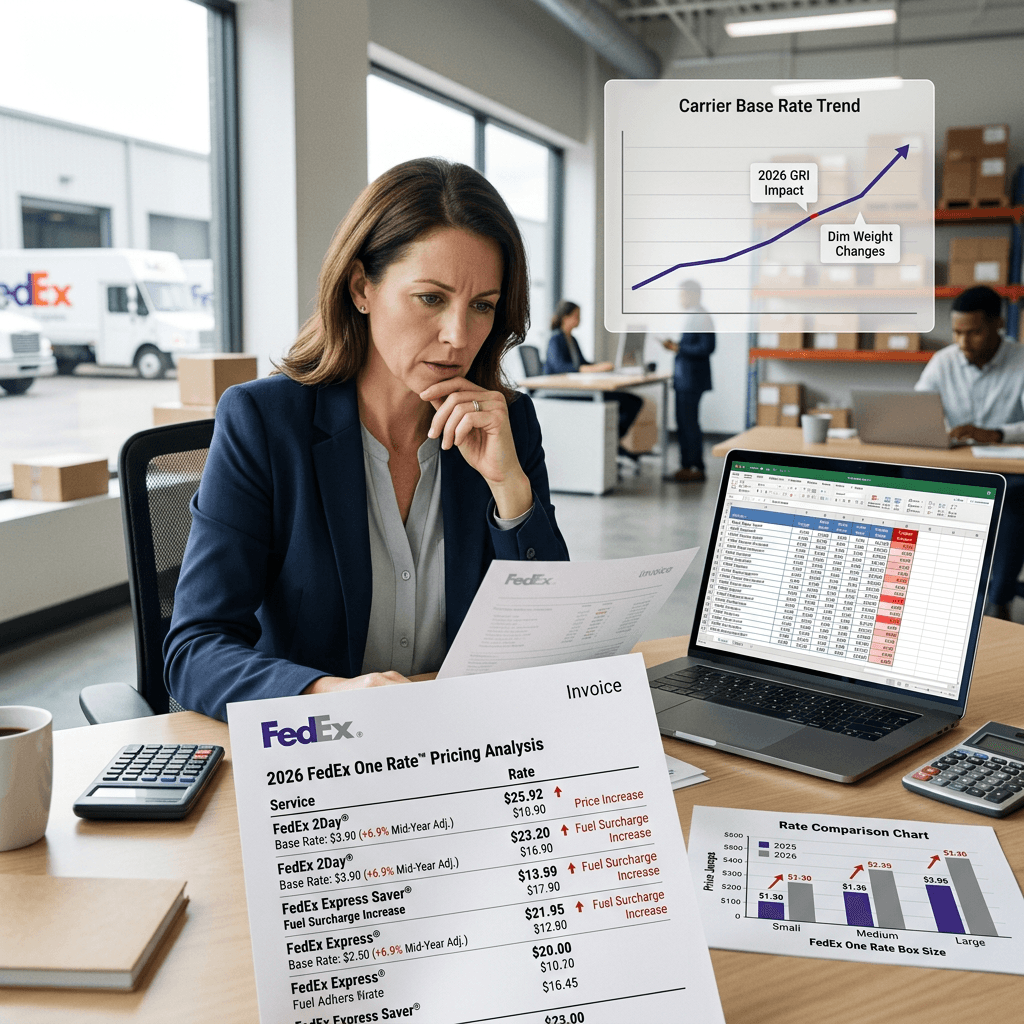
FedEx slipped a significant mid-year price hike past its shippers over Easter weekend. Here’s exactly what’s changing, who it hits hardest, and what you should do before April 20.
The Timing Was Not an Accident
Carriers have a long playbook for rate announcements, and burying them in holiday weekends is a proven chapter. The fewer eyes on the announcement, the fewer questions it generates, and the smoother the increase rolls out. By the time most customers return from the long weekend and open the email, there are only 17 days left before the new rates kick in and that window is already shorter once you account for the days already lost.
This particular announcement is notable even by carrier standards. The email contained no dollar figures, no service-level breakdown, and no percentage increase. It simply directed customers to their pricing agreement. The actual numbers, a 6.9% average base cost increase on FedEx 2Day and Express Saver, were sitting in a linked PDF that most recipients never opened.
View FedEx One Rate Pricing effective April 20, 2026
Key Context
This is the fourth One Rate pricing adjustment in less than a year. FedEx changed 2Day and Express Saver rates in July 2025, raised Special Pricing bases in October 2025, updated rates again in January 2026 as part of the annual GRI, and now is issuing a full mid-year increase in April 2026. The era of One Rate as a stable, set-it-and-forget-it program is over.
What Is FedEx One Rate, and Why It Matters
FedEx One Rate launched as a simplified flat-rate option for domestic U.S. shipments using FedEx-supplied packaging. The appeal was real: no dimensional weight calculations, no zone-based complexity, and critically fuel, residential, and delivery area surcharges bundled in. For e-commerce and B2B shippers, it removed the billing surprises that make parcel invoices unpredictable.
It worked. One Rate became FedEx’s dominant tool for capturing 2-day express volume. The program covers multiple service levels, Express Saver, FedEx 2Day, Standard Overnight, and Priority Overnight, but its center of gravity is FedEx 2Day. For a wide swath of e-commerce, subscription box, and B2B replenishment shippers, “2Day One Rate” became the default answer to how to ship quickly without surprises on the invoice.
“That dominance in the 2-day market is exactly why FedEx can get away with this kind of announcement cadence. When your customers have already built their shipping workflows around your service, the switching cost is high.”
Worth noting: because fuel is already bundled into One Rate flat pricing, when fuel costs rise, FedEx absorbs it on paper, then recovers it through base cost increases like this one. The customer pays for the fuel increase either way, just through a different mechanism.
The Numbers FedEx Didn’t Put in the Email
The One Rate Special Pricing agreement, the document referenced in the April email, has been updated with rates effective April 20, 2026, published side-by-side with the current rates (effective January 19–April 19, 2026). Here is what’s actually changing for FedEx 2Day and Express Saver, the most widely used service levels in the program:
For Priority Overnight, the average increase is 5.2%, ranging from $1.09 on an Extra Small Box to $3.57 on an Extra Large Box, meaningful, but more moderate than the 2Day tier.
Why the “Discount Stays the Same” Argument Doesn’t Hold
One Rate Special Pricing customers ship against a contract-specific base cost before their incentive (discount) is applied, not the retail rate table. When FedEx raises the base, every One Rate shipment gets more expensive, even if your discount percentage is unchanged.
A customer with a 15% incentive off the old base and a 15% incentive off the new base is still paying more. They’re just paying 15% less of a bigger number. This is the mechanism that makes these increases particularly effective: they don’t appear as a change in your contract terms. They show up as a change in the base costs your contract references. If you’re not actively watching those base costs, you won’t notice until the invoices arrive.
We’re also hearing from parcel shippers that FedEx representatives are taking a harder line than usual on rate negotiations and incentive renewals. Requests to offset the base cost increases with improved incentives are being met with more resistance than in prior cycles, particularly for mid-market shippers without substantial leverage.
The Broader 2026 Context
This April increase doesn’t exist in isolation. FedEx’s January 2026 annual General Rate Increase averaged 5.9% across standard list rates, the third consecutive year at that level. One Rate 2Day saw increases ranging from 5.1% to 10.9% in that January round, making it the most aggressively adjusted product in the portfolio even before this April update.
The pattern is deliberate. One Rate has become a significant enough revenue line that FedEx is managing it actively and on a compressed schedule. Longer-haul shipments to Zones 7 and 8 have seen disproportionate hikes above the 5.9% headline, and packages in the 11–20 lb weight range, a common e-commerce sweet spot, have faced above-average increases throughout 2026.
The frequency of adjustments tells you something important: FedEx no longer views One Rate as a stable pricing structure. It is actively managing yield on the program, and the customers best positioned to respond are the ones paying attention to every update.
What You Should Do Before April 20
- Pull your actual contract rate table, not the retail PDF.The FedEx One Rate retail pricing PDF on fedex.com is a different document with different numbers than the Special Pricing agreement your incentives are calculated against. Find the agreement linked to your account and confirm the April 20 rates are reflected.
- Model the impact on your actual shipment mix. Don’t just look at the rate table in isolation. Take your last quarter’s One Rate volume, by packaging type and service level, and apply the new base costs. If you shipped 10,000 Small Boxes on 2Day last quarter at a $21.79 base, your new base is $23.29. That $1.50-per-package increase compounds across your entire volume in a hurry.
- Have a specific conversation with your FedEx Rep. A generic “what can you do about rates?” call will get you nowhere. Come to the conversation with your modeled impact figure, total dollar increase per quarter, and ask specifically whether your incentive structure can be adjusted to offset the new base costs. Be prepared for resistance, but specificity is your best lever.
- Audit your packaging for cubic volume reclassification risk. Any FedEx One Rate Envelope measuring more than 3 inches along its shortest side, or any Pak measuring more than 5 inches, gets reclassified as a box and priced by cubic volume. With base costs rising, that reclassification penalty is larger than it’s ever been. Make sure your packaging isn’t triggering it.
- Evaluate whether One Rate is still the right structure. For some shippers, the simplicity premium of One Rate no longer justifies the cost, especially if your average package weight and dimensions would price more favorably under standard rates with proper dimensional weight optimization. It’s worth running the comparison on your actual lanes.
The Bottom Line
FedEx One Rate was built on the promise of predictability. A flat rate you could count on, with the complexity of surcharges removed from the equation. That promise is being steadily eroded, not through any single dramatic announcement, but through a cadence of quiet adjustments, each framed as routine, each timed to generate as little friction as possible.
The April 20 update is not routine. A 6.9% average mid-year base cost increase, announced on a holiday Friday afternoon, compounding on top of an already aggressive January GRI, is a signal that One Rate is being managed as a high-yield product line and that FedEx is confident enough in the stickiness of the program to test how much customers will absorb without responding.
The best thing you can do right now is open the email, pull the document, run the numbers, and make a decision rather than letting the April 20 effective date arrive without having done either.
Need Help Modeling the Impact?
ebb Logistics helps parcel shippers cut through carrier pricing complexity, model rate changes against their actual shipment data, and negotiate from a position of knowledge.
We’ll tell you honestly if we can help.