

Home / What we do / Parcel audit
Parcel audit services and software
ebb Logic™, our proprietary audit platform, checks every UPS and FedEx invoice against your carrier agreement each week. Our team pursues the eligible refunds and reports the recurring billing errors, so you can see which charges are wrong and what is being done to recover them.
What is a parcel audit?
A parcel audit checks every shipment on your carrier invoices against your own contract and the carrier’s service guarantee, then files claims for anything recoverable. ebb Logic™, our proprietary audit platform, runs that check every week: missed discounts, duplicate charges, invalid address corrections, wrong residential, delivery area and dimensional charges, fuel errors and late deliveries on guaranteed services. Our team files the claims. The audit runs on contingency, so you pay only from what is recovered.
A parcel invoice audit checks for billing errors and contract compliance. ebb Logic™ reviews service failures, duplicates, address corrections and surcharges, then checks each charge against your discounts, tiers, minimums and accessorial terms. It runs every week, so problems are caught soon after they begin.
Recover refunds and catch recurring billing errors.
Carriers calculate thousands of charges using detailed contract terms. Checking them by hand is not practical, and errors repeat across billing cycles without being noticed. ebb Logic™ checks every line, every week.
ebb Logic™ checks for late deliveries covered by service guarantees, duplicate charges, incorrect address corrections, residential surcharges and dimensional weight errors. Eligible refunds must be requested within the carrier claim window, which is why the weekly run matters.
Some charges are correct under the agreement but could be reduced through better terms. ebb Logic™ identifies these alongside billing errors, and our team reports both so you can address them.
ebb Logic™ extracts roughly six hundred data points from a typical parcel agreement, depending on its contents, and checks invoice lines against them. It also looks for gaps, such as a discount that covers one service but excludes another you regularly use.
What the audit checks.
ebb Logic™ runs thirty active rules against every invoice line on every run, with rule sets written for the billing of each carrier. These are the main areas covered. Findings include the calculation, the expected charge and the billed amount.
- Earned discount not applied
- Compares the earned incentive in your agreement with the discount applied to each invoice line.
- Ground commercial and residential
- Checks commercial and residential ground discounts separately against their respective terms.
- Zero-incentive base freight
- Flags eligible shipments billed at full published rates without an agreed incentive.
- Accessorial shortfall
- Compares each accessorial charge with its negotiated rate or discount.
- Delivery area surcharge category
- Checks the billed delivery area surcharge category against the destination's applicable category.
- Fuel shortfall
- Recalculates fuel using the relevant weekly index and the basis and concessions in your agreement.
- Dimensional divisor
- Calculates dimensional weight from recorded package dimensions using your contracted divisor.
- Ground Saver and Express base
- Checks Ground Saver and Express base discounts against the specific terms for each service.
- Duplicate billing
- Checks for the same shipment billed more than once, within an invoice or across invoices.
- Minimum charge adjustments
- Verifies that the minimum net charge matches your agreement when it overrides the discounted rate.
- Late delivery on a guaranteed service
- Compares delivery with the service commitment and checks whether the applicable guarantee was active.
- Manifested but never shipped
- Identifies charges for labels where the records show no carrier possession of the package.
What the audit produces.
Each example shows the audit rule, the expected charge under the agreement, the billed amount and the difference.
| Rule | Service | Zone | Weight | Expected | Billed | Variance |
|---|---|---|---|---|---|---|
| EARNED_DISCEarned discount | Ground Commercial | 5 | 12 lb | $9.84 | $14.21 | +$4.37 |
| FUEL_SHORTFALLFuel | Ground Residential | 4 | 7 lb | $2.61 | $3.34 | +$0.73 |
| DIM_WRONG_DIVISORDIM divisor | Ground Commercial | 6 | 18 lb | $16.40 | $22.07 | +$5.67 |
| DAS_CATEGORY_MISMATCHDAS category | Home Delivery | 7 | 3 lb | $4.15 | $7.40 | +$3.25 |
| DUP_CROSS_INVOICEDuplicate, cross invoice | Next Day Air Saver | 3 | 2 lb | $0.00 | $31.88 | +$31.88 |
| ACCESSORIAL_SHORTFALLAccessorial | Ground Commercial | 2 | 26 lb | $3.95 | $6.75 | +$2.80 |
| GSAV_DISCGround Saver discount | Ground Saver | 5 | 1 lb | $5.62 | $6.39 | +$0.77 |
| Variance on the lines shown | +$49.47 | |||||
Every finding carries the arithmetic behind it: the rule, the terms it read from your agreement, the expected charge, the billed charge and the difference. A finding you cannot check is a finding you cannot take to a carrier.
| Service | Committed | Delivered | Late by | Outcome | Claim value |
|---|---|---|---|---|---|
| Next Day Air Early | Tue 08:00 | Tue 10:42 | 2h 42m | Claim ready | $68.40 |
| Next Day Air Saver | Wed 15:00 | Thu 09:15 | 18h 15m | Claim ready | $41.20 |
| 2nd Day Air A.M. | Thu 12:00 | Thu 16:38 | 4h 38m | Claim ready | $29.75 |
| Ground Commercial | Mon | Wed | 2 business days | Contract claim | $14.05 |
| Home Delivery | Fri | Mon | 1 business day | No guarantee | n/a |
| Next Day Air | Mon 10:30 | Mon 14:02 | 3h 32m | Window passed | $52.60 |
UPS gives you 15 calendar days to file a guarantee claim. A claim that is correct on the merits is worth nothing the day after the window closes, which is why the tracker runs weekly and files automatically rather than at month end.
Estimate potential recovery
Three to five percent of monthly parcel spend is the planning range for recoverable billing error. Move the slider to your monthly parcel spend.
What is in this number, and what is not
The band is recoverable billing error: missing earned discounts, duplicate billing, invalid address corrections, delivery area and dimensional charges that should not have applied, fuel shortfalls, and late deliveries on services that still carry an active guarantee.
It excludes structural overspend, meaning charges billed correctly under a contract that should have been written differently. That is usually the larger number and it is recovered by renegotiating, not by filing.
Your real figure comes from your own invoices. The first look is free and tells you which half of this your money is sitting in.
What you actually receive.
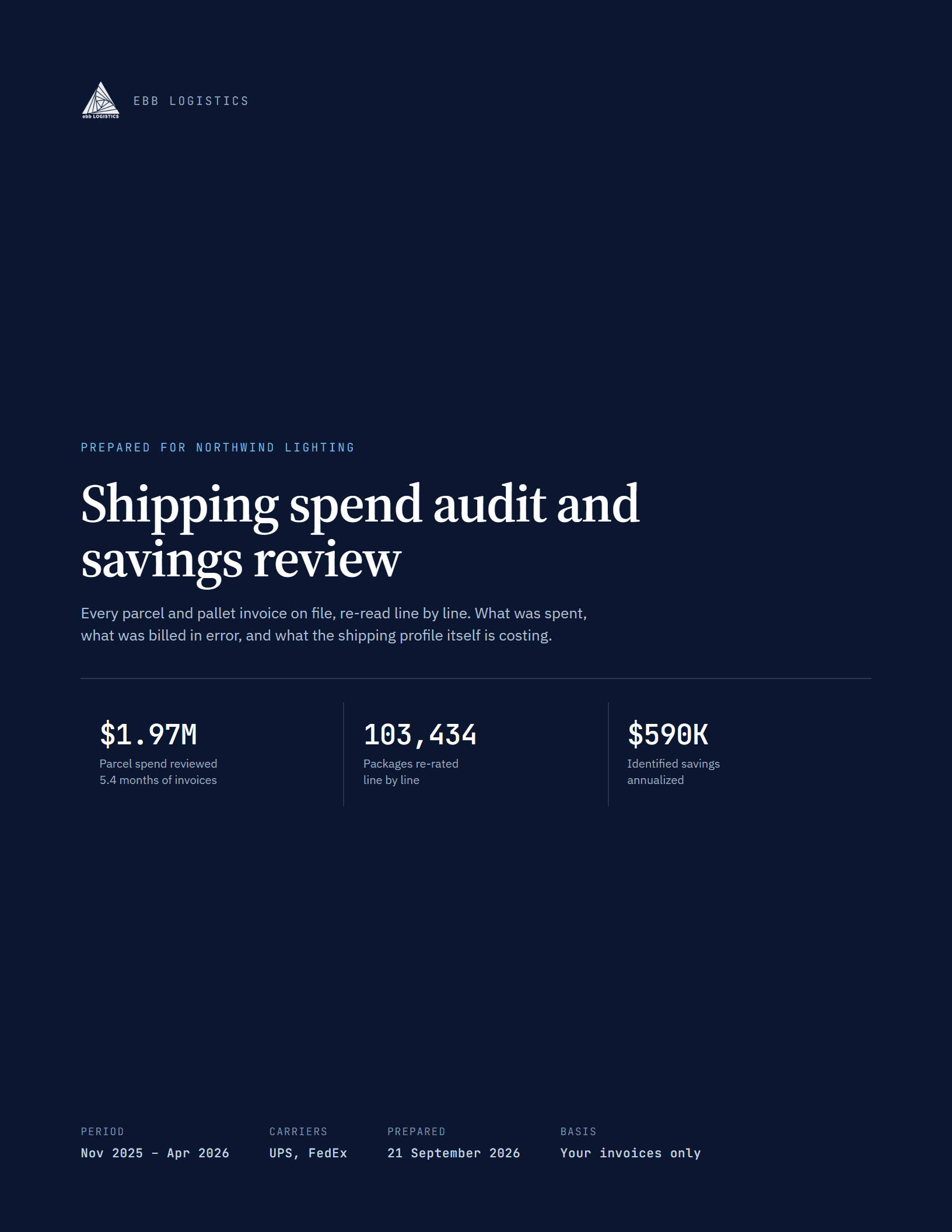
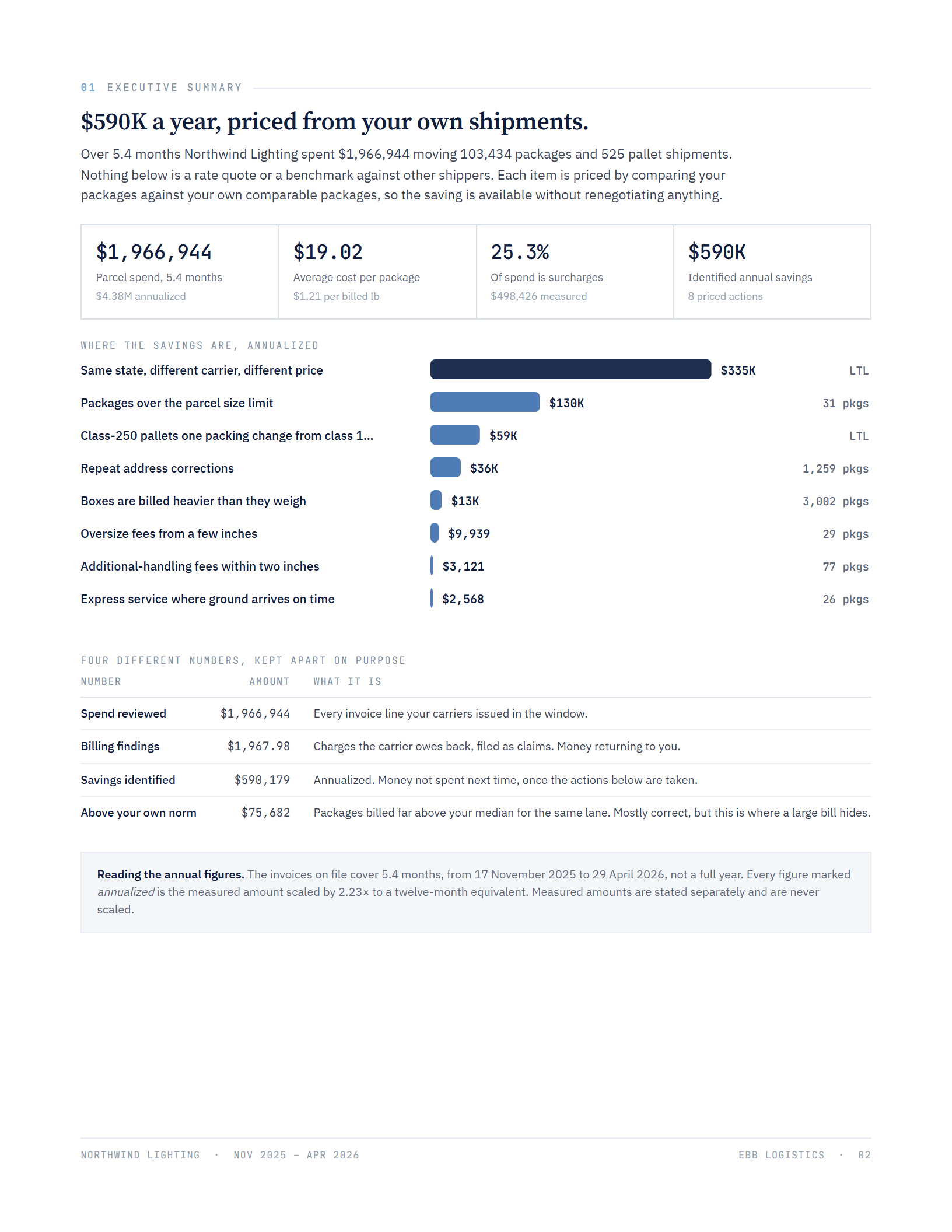
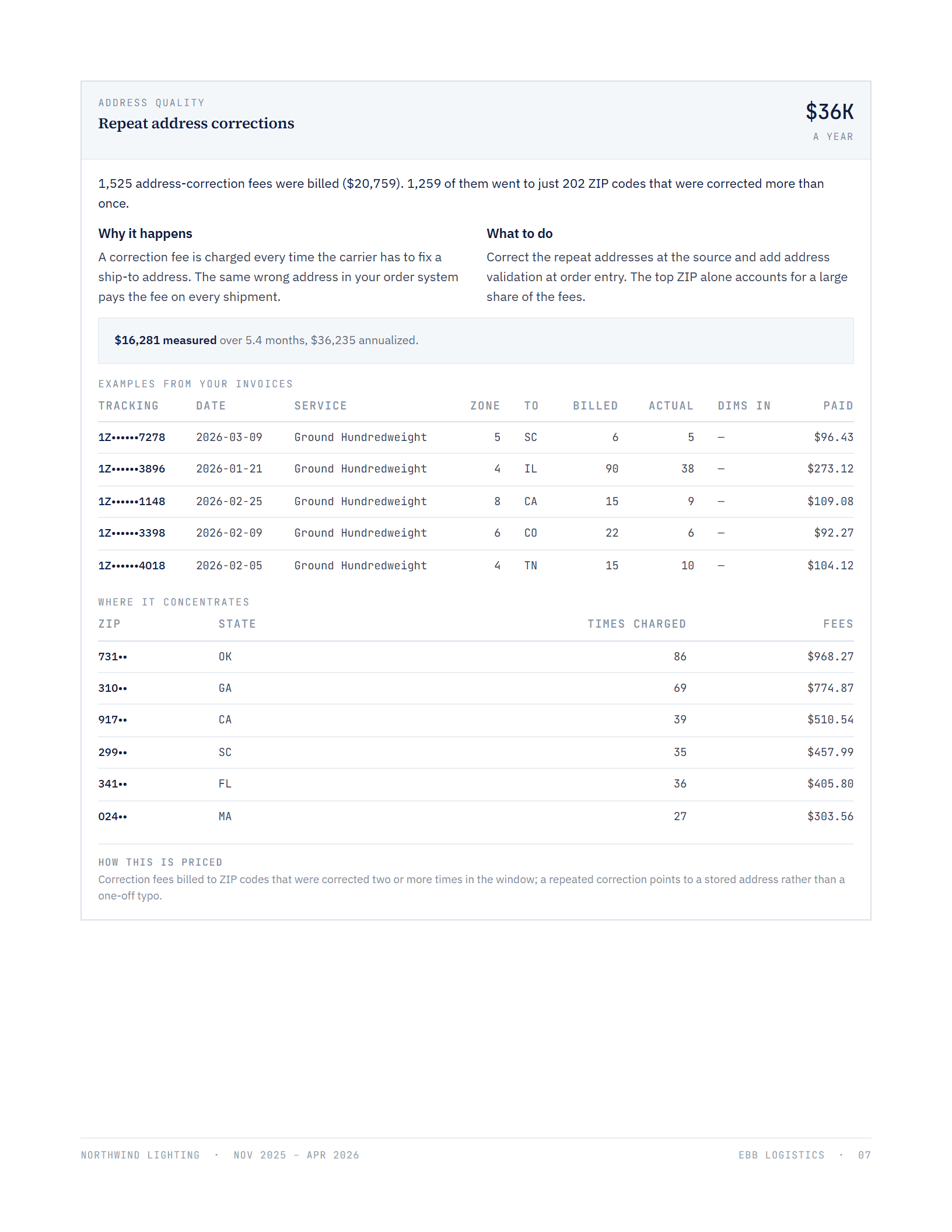
This sample report shows the audit rule, contract term and invoice line behind each finding. It uses a shipper's billing data with identifying details masked.
What makes this different.
Rated against your contract, not a rate card
ebb Logic™ recalculates charges using your agreed discounts, tiers, minimums and accessorial terms. This identifies missing discounts that a comparison with published rates would miss.
Claims filed before the deadline
ebb Logic™ runs every week, and our team files eligible claims within the carrier deadline. Timing matters because late claims can be rejected even when the billing error is valid.
Contract issues identified alongside refunds
Some high charges follow the contract correctly but point to terms worth renegotiating. ebb Logic™ separates those findings from billing errors that may qualify for refunds, and our team explains both.
Late charges tracked to the shipment
Carriers bill some charges weeks after the shipment: address corrections, dimensional adjustments, residential and additional handling surcharges. ebb Logic™ ties each late charge back to the original shipment and checks it against the same contract terms, so a late-billed error is caught and claimed like any other.
How this actually runs.
Connect your billing data
Provide read-only access to your carrier billing account or a weekly export. ebb Logic™ reads that data without changing your shipping system.
Week 1Rate every shipment against your contract
ebb Logic™ recalculates each charge using your discounts, tiers, minimums and accessorial terms, then compares it with the billed amount. Every finding shows the shipment, the charge and the contract term behind it.
WeeklySubmit eligible refund claims
Our team files eligible claims from those findings, covering service failures, duplicates, address corrections, residential and dimensional charges, and missing delivery records, within carrier deadlines.
WeeklyReport terms worth renegotiating
ebb Logic™ separates charges that are correct under the contract but could be reduced through a change in terms, and our team reports them each month.
Monthly
Questions shippers ask first.
How much money does a parcel audit typically recover?
Does UPS or FedEx actually refund late deliveries?
How far back can you claim?
Will filing claims annoy our carrier or hurt our rates?
Do we have to change our shipping systems?
What does a parcel audit cost?
Is this parcel audit software, or a service?
Is this the same as a freight bill audit?
What does a parcel audit actually check?
How much can a parcel audit recover?
How do I know if UPS or FedEx is overcharging me?
What is the difference between a parcel audit and a freight audit?
Can you verify that our negotiated discounts were applied?
How long does implementation take, and what do you need from us?
Is our shipping and contract data secure?
Where do recovered credits appear?
How many shipments do we need before an audit makes sense?
Can audit findings help with our next carrier negotiation?
Guides and tools.
How fuel surcharges are calculated
The index tables, the base fuel is charged on, and FedEx against UPS.
Guide02Fuel surcharge tracker
Compare published FedEx and UPS weekly fuel surcharge percentages by service group and review the index tables used to set them.
Tool03Dimensional weight history
Every divisor and scope change since 2007: 194 to 166 to 139, and DIM on every Ground package.
Guide04Additional handling and oversize checker
Enter a package’s dimensions, weight and packaging to see whether it triggers a UPS or FedEx additional handling, oversize or large package charge in 2026, which measurement did it, the published amount by zone, and how far the box is from the next threshold.
Tool05Parcel audit vs rate audit vs contract optimization
Was the bill wrong, were your terms applied, or are the terms weak? What each review finds and where to start.
Guide06USPS return to origin
Why USPS returns packages, which classes return free, why postage is not refunded, and how to intercept or prevent a return.
GuideRelated work.
Contract negotiation
We review twelve months of your shipping invoices and compare your contract terms with those available to similar shippers. This parcel rate benchmarking helps us identify changes worth requesting. We then negotiate directly with your carrier.
For shippers reviewing or renewing carrier agreements02Claims filing
Loss and damage claims prepared, filed, and tracked to resolution, including the documentation requirements that get most claims denied.
For shippers writing off loss and damage as a cost of doing business03Freight and truckload
LTL and truckload rate agreements, accessorial schedules, and freight bill auditing, including the classification changes now in force.
For shippers with meaningful LTL or truckload volumeRequest a free contract review.
Send your agreement for a written review of potential savings and recommended next steps.
Or call 888-356-4421
Free, and no obligation. A written evaluation back inside 48 hours. No fee unless we find documented savings. How we handle your documents
- Your current agreement, any carrier
- One recent invoice, if you have one
- A written evaluation back inside 48 hours