


Home / What we do / LTL freight audit
LTL freight audit and overcharge recovery
Every LTL invoice checked against the contract, the governing tariff, the bill of lading, the freight class and the services the carrier actually provided.
What is an LTL freight audit?
An LTL freight audit is the process of checking every carrier invoice against your agreement, the governing tariff, the bill of lading and how the shipment actually moved. It verifies the base rate and discount, minimum charge, freight class and NMFC code, billed weight and any reweigh, the fuel surcharge for that week, and every accessorial. Each difference becomes a documented finding carrying the charge, the term behind it and the calculation. Our team files those findings as claims, so the carrier bills the rates and terms you agreed to.
Our LTL freight audit checks rates, minimum charges, freight class, NMFC, billed weight, reweighs, fuel and accessorials. Every discrepancy is documented with the contract term and the calculation behind it, and our team files the claim that holds the carrier to the terms you agreed.
Check the details behind each LTL charge.
An LTL charge depends on freight class, billed weight, base rate, discount, minimum charge and fuel. Not all of these inputs are clear on the invoice.
We compare the bill with shipment records and contract terms to check reclassifications, reweighs, missing discounts, fuel calculations and accessorials such as liftgate service.
Each discrepancy includes the calculation and supporting records needed to explain the dispute to the carrier.
What the audit checks.
ebb Logic™, our audit engine, runs these checks on every LTL invoice, comparing each charge with your contract, the shipment records and the applicable tariff.
- Contracted rate and discount
- Checks the contracted discount by lane, freight class and weight break.
- Base tariff and rate base
- Verifies that the carrier used the base tariff named in the agreement.
- Absolute minimum charge
- Checks the negotiated minimum, any waiver, and whether the calculation uses discounted or undiscounted linehaul as required.
- FAK provision
- Checks that the FAK class in the agreement was applied to eligible freight.
- Freight class and NMFC code
- Compares the billed class with the bill of lading and the applicable NMFC item classification.
- Density calculation
- Pounds per cubic foot computed from the declared dimensions and weight, against the restructured NMFC density scale in force since July 2025. Density now determines class for most palletized freight from six pounds per cubic foot upward.
- Billed weight and reweigh
- Compares billed weight with the bill of lading, any certified reweigh record and the tolerance in your agreement.
- Carrier reclassification
- Reviews the inspection records and other evidence supporting a carrier's class change.
- Fuel surcharge and index
- Checks the fuel percentage, applicable DOE index week, calculation basis and any contractual cap.
- Accessorial charges
- Verifies that each accessorial service was required and billed at the agreed rate, including liftgate, limited access, detention, redelivery, overlength and hazmat.
- Duplicate invoices and duplicate payments
- Checks repeated PRO numbers, duplicate payments and shipments billed by both a broker and carrier.
- Balance-due bills and the 180-day window
- Supplemental bills arriving after the federal window has closed, which are not owed, and charges on your side approaching the same deadline.
- Delivery and service failure
- Reviews delivery records and whether a missed guaranteed commitment qualifies for a claim.
What you actually receive.
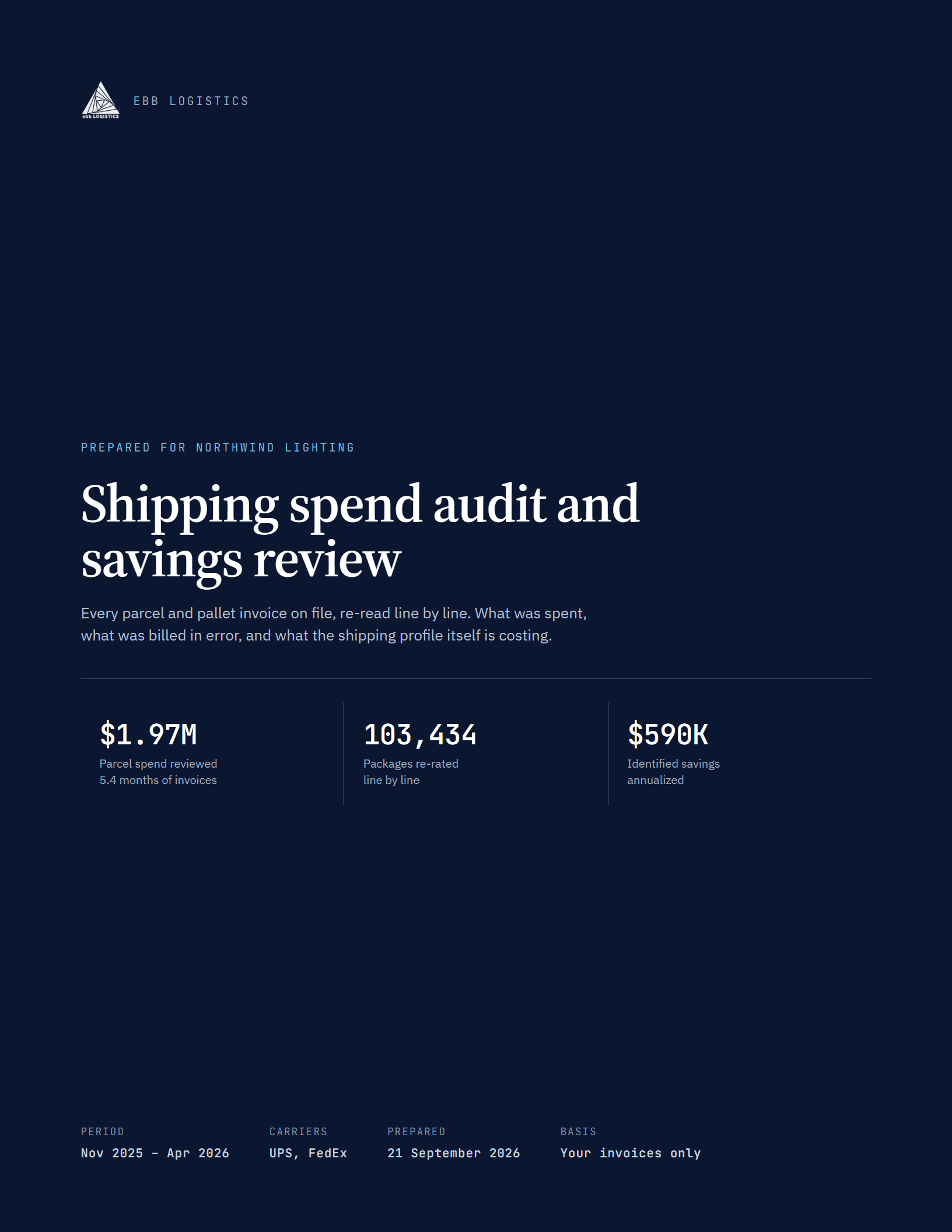
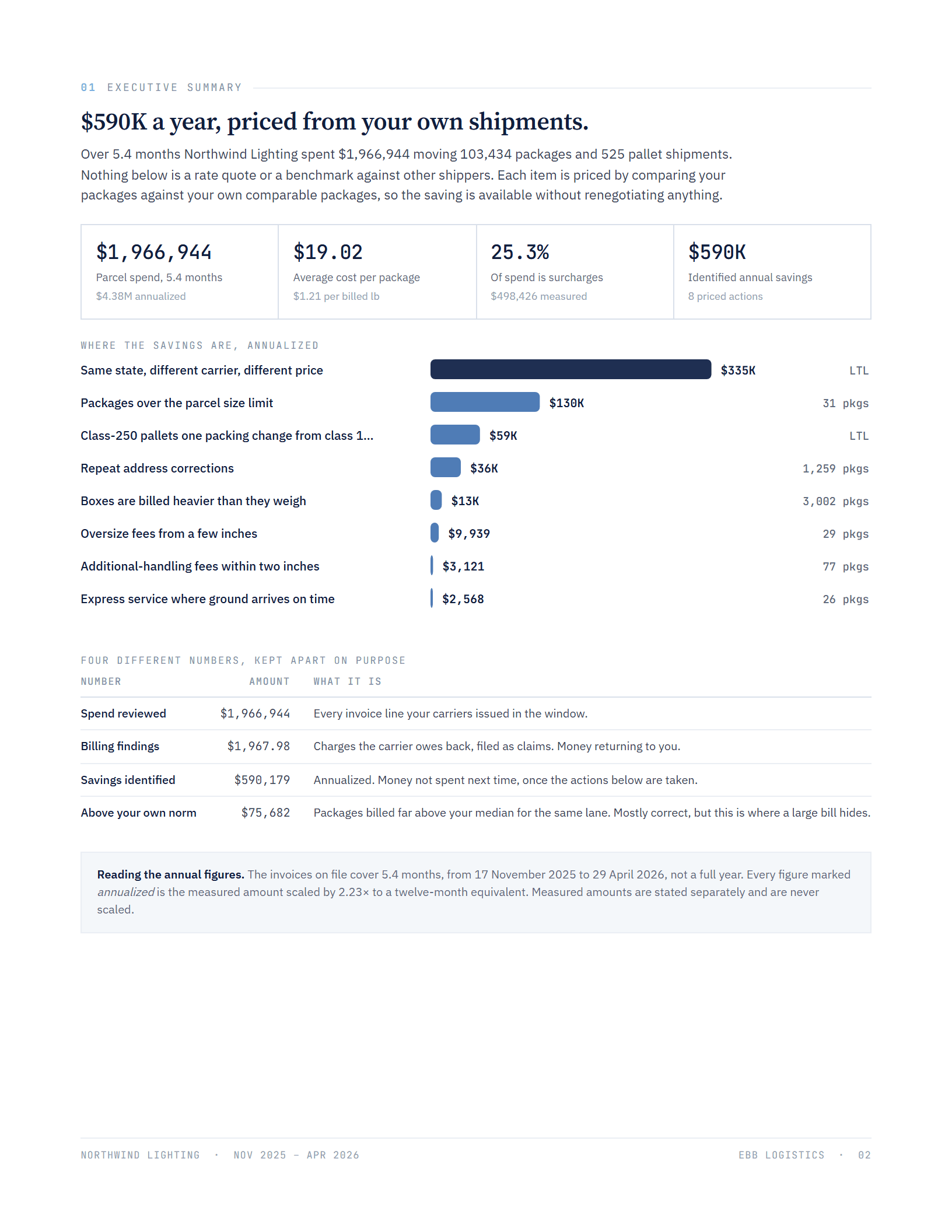
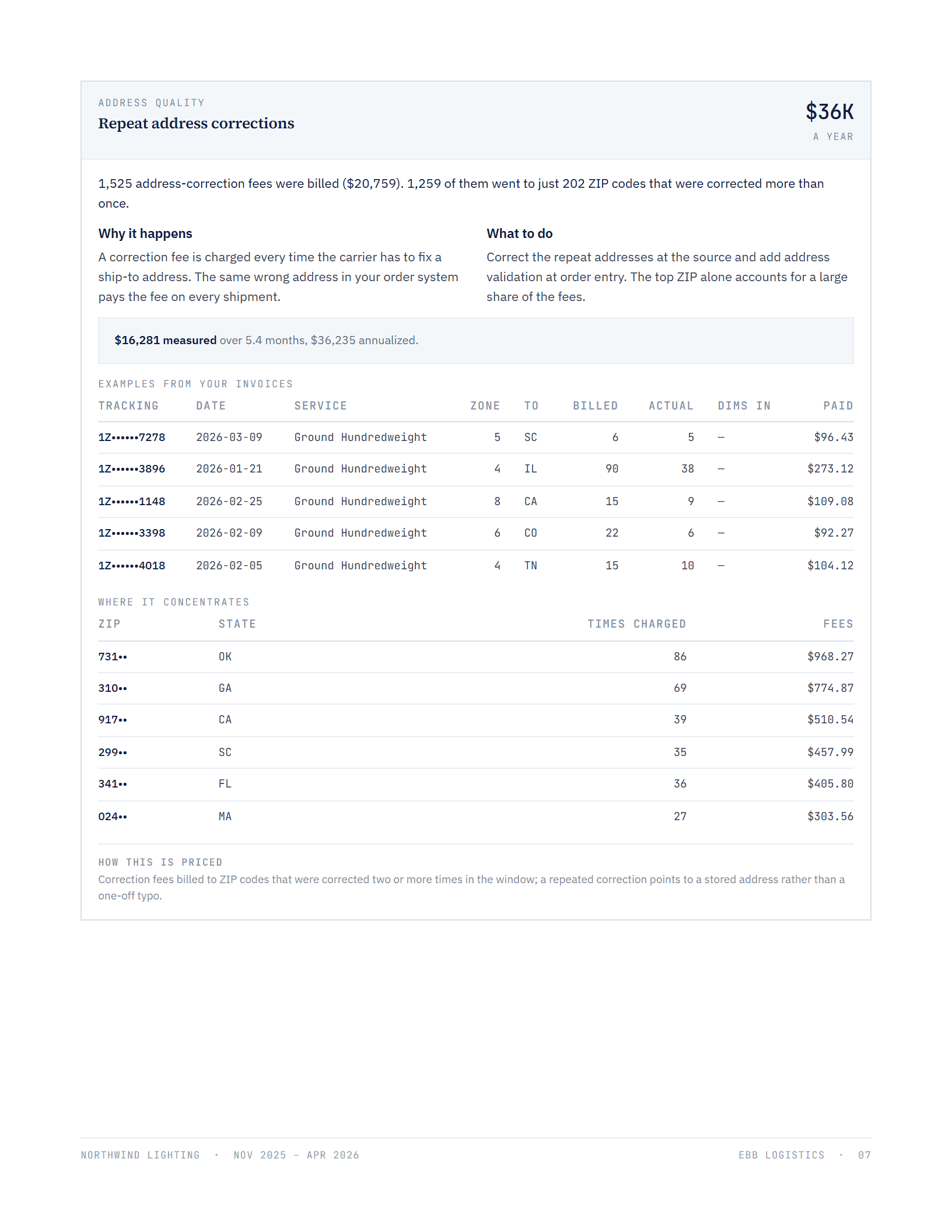
Parcel and pallet freight in one document, each priced the same way: against the shipper's own shipments rather than a published tariff. Built from real invoices, with the shipper's identity masked and every figure left as it was found.
What makes this different.
Evidence for every dispute
Each finding connects the carrier invoice, bill of lading, applicable rate or tariff, and classification rule. You can follow the discrepancy through the dispute and any resulting credit.
Checked against your agreement, not published rates
The comparison uses the lane discount, minimum charge, FAK provisions and fuel table in your signed agreement. A check against published rates cannot find a discount the carrier agreed to and then did not apply.
Disputes tracked against deadlines
Federal law gives a shipper 180 days from the bill to contest it, and gives the carrier the same 180 days to issue a back-bill. Both directions matter, and both argue for checking invoices as they arrive rather than in a quarterly review.
How this actually runs.
Send invoices and the agreement
Send carrier invoice files, shipment or bill-of-lading records, and the pricing agreement. A TMS export can provide shipment details. There is no software to install.
SetupRebuild the shipment
ebb Logic™ matches each invoice with the shipment lane, weight, class, NMFC item, dimensions, density and the services actually provided.
Week 1Re-rate and compare
ebb Logic™ recalculates the bill from your agreement and the governing tariff, then compares each charge with what the carrier invoiced. Every difference becomes a finding.
Week 1File the claim with the evidence attached
Our team files each finding with the chain behind it: the invoice line, the shipment record, the contract clause or tariff rule, and the calculation. Carriers must acknowledge a claim within 30 days and pay, decline or settle within 60.
Weeks 2–3Report recovery and recurring issues
We report disputed amounts, recoveries and patterns in reweighs, accessorials and lane pricing. These findings also help prepare for the next negotiation.
Ongoing
Questions shippers ask first.
What are the most common LTL billing errors?
How do you audit an LTL freight invoice?
Can an LTL audit detect incorrect freight classifications?
Can a freight audit challenge an unsupported reweigh?
How are FAK provisions checked during an LTL audit?
Can freight audit software detect duplicate invoices?
What is the difference between pre-payment and post-payment freight audit?
How far back can an LTL freight audit recover overcharges?
What documents are needed for an LTL freight audit?
Does an LTL audit compare the invoice with the bill of lading?
Is this software or a service?
Can LTL audit software integrate with our TMS or ERP?
Will freight auditing delay carrier payments?
Who handles disputes with the LTL carrier?
What is the difference between an LTL audit and a parcel audit?
Do LTL freight auditors work on contingency?
Can audit data help with the next LTL contract negotiation?
Related work.
LTL contract negotiation
We negotiate LTL base rates, lane and class discounts, minimum charges, freight-all-kinds (FAK) provisions, fuel and accessorials. We use your shipment history to compare terms, then check invoices after the new agreement takes effect.
For shippers moving pallets on one or more LTL carriers02Parcel audit
A parcel invoice audit checks for billing errors and contract compliance. ebb Logic™ reviews service failures, duplicates, address corrections and surcharges, then checks each charge against your discounts, tiers, minimums and accessorial terms. It runs every week, so problems are caught soon after they begin.
For shippers who want their invoices checked against their carrier agreement03Freight and truckload
LTL and truckload rate agreements, accessorial schedules, and freight bill auditing, including the classification changes now in force.
For shippers with meaningful LTL or truckload volumeRequest a free contract review.
Send your agreement for a written review of potential savings and recommended next steps.
Or call 888-356-4421
Free, and no obligation. A written evaluation back inside 48 hours. No fee unless we find documented savings. How we handle your documents
- Your current agreement, any carrier
- One recent invoice, if you have one
- A written evaluation back inside 48 hours