
FedEx delivery area surcharge 2027: 2,533 ZIP codes move to Remote

The short version
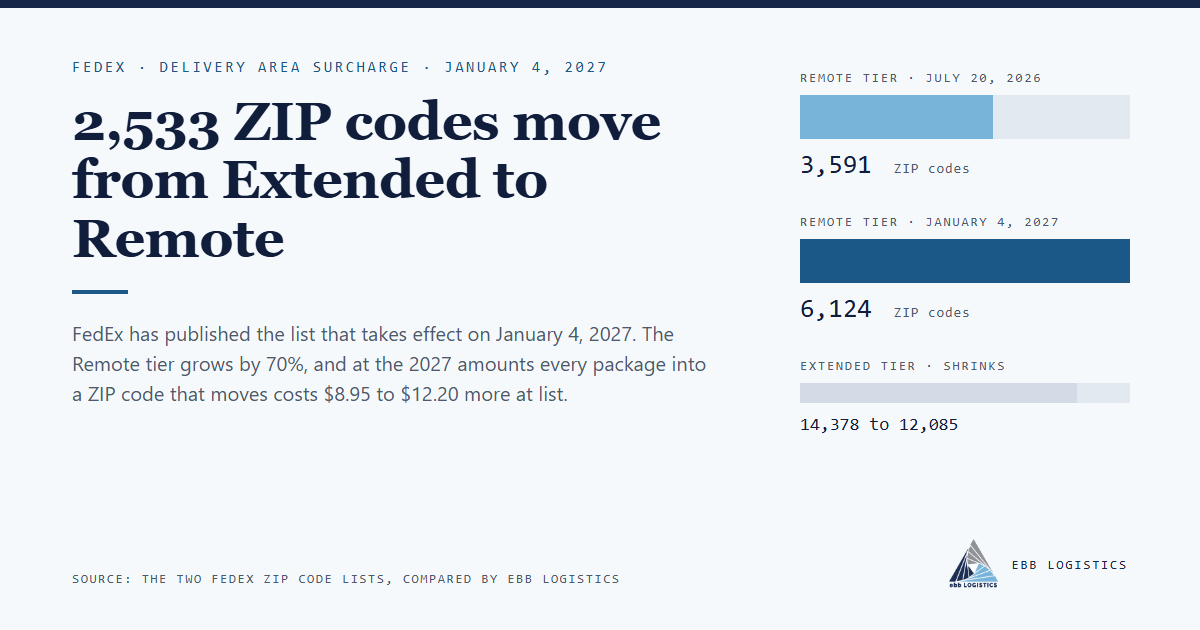
- 2,533 ZIP codes move from Extended to Remote on January 4, 2027, which is 17.6% of every ZIP code in the Extended tier today.
- The Remote tier grows from 3,591 ZIP codes to 6,124, an increase of 70.5%, while the Extended tier shrinks from 14,378 to 12,085.
- At the published 2027 amounts the move adds $8.95 per residential package and $12.20 per commercial package at list, because Remote becomes a flat $17.75 for both; every tier's amount rises in January, so ZIP codes that stay put cost more too.
- Missouri, Arkansas, Texas, Kansas and Oklahoma have the most ZIP codes moving; Minnesota, Pennsylvania and South Carolina see their Remote tier more than double.
- The UPS list is unchanged since its June 2025 workbook, so from January the two carriers will disagree on roughly 2,500 ZIP codes they agree on today.
FedEx has published the delivery area surcharge ZIP code list that takes effect on January 4, 2027, alongside the list in force today. Comparing the two, 2,533 ZIP codes move from the Extended tier to the Remote tier, 240 move from the standard delivery area tier to Extended, and 45 are surcharged for the first time. The Remote tier grows from 3,591 ZIP codes to 6,124. FedEx has published the 2027 amounts beside the list: a residential package to a ZIP code that moves to Remote goes from the $8.80 Extended surcharge to the $17.75 Remote surcharge, $8.95 more, and a commercial package from $5.55 to $17.75, $12.20 more, at list, before fuel and before any negotiated concession on the surcharge.
We found this by reading both documents from fedex.com and comparing them ZIP by ZIP. FedEx has not announced the change in those terms; its rate change page simply links both lists. The per-ZIP results are in our delivery area surcharge ZIP code lookup, which shows the tier today and the tier from January 4 for any ZIP code.
What changed between the two FedEx lists
FedEx publishes its delivery area surcharge ZIP codes as a single document in three contiguous-US tiers, plus Alaska, Hawaii and intra-Hawaii. The current document is effective July 20, 2026. The one effective January 4, 2027 is already on the same page. The table below is the count of ZIP codes in each tier in each document.
| Tier | Effective July 20, 2026 | Effective January 4, 2027 | Change |
|---|---|---|---|
| Delivery area surcharge | 7,682 | 7,487 | -195 |
| Extended delivery area | 14,378 | 12,085 | -2,293 |
| Remote area | 3,591 | 6,124 | +2,533 |
| All contiguous US | 25,651 | 25,696 | +45 |
Net tier totals obscure the full movement, because the Extended tier gains ZIP codes from the standard tier while losing others to Remote. Tracked individually, 2,533 ZIP codes go from Extended to Remote, 240 go from the standard tier to Extended, and 45 that carry no surcharge today are added to the standard tier. No ZIP code moves down a tier and none is removed. Alaska, Hawaii and intra-Hawaii are identical in both documents. The FedEx pickup area surcharge list is the same set of ZIP codes as the delivery list on both dates.
What the move costs per package
The delivery area surcharge is charged per package on top of the transportation rate and, for residential deliveries, on top of the residential delivery charge. It is applied after any discount and before fuel. FedEx publishes the amounts in its annual surcharge changes document, and the 2027 document is already out: the same date as the new ZIP list, and the same figures for FedEx Express and FedEx Ground.
| Tier | 2026 commercial | 2026 residential | 2027 commercial | 2027 residential |
|---|---|---|---|---|
| Delivery area surcharge | $4.45 | $6.60 | $4.70 | $7.00 |
| Extended delivery area | $5.55 | $8.80 | $6.00 | $9.60 |
| Remote area | $16.75 | $16.75 | $17.75 | $17.75 |
So a ZIP code moving from Extended to Remote goes from $8.80 today to $17.75 from January on a residential package, an increase of $8.95 or 102%, and from $5.55 to $17.75 on a commercial package, an increase of $12.20 or 220%. A ZIP code moving from the standard tier to Extended adds $3.00 residential and $1.55 commercial. A newly listed ZIP code adds $7.00 residential or $4.70 commercial where there was nothing. A ZIP code that stays in its tier still rises with the amount: $0.40 residential in the standard tier, $0.80 in Extended, $1.00 in Remote.
These are list amounts. An agreement that caps the surcharge, discounts it, or waives it for a share of volume pays less, and the figures a shipper should budget are the list increase multiplied by its own packages and reduced by whatever its agreement says. At list, a shipper sending 10,000 residential packages a year into ZIP codes that move to Remote pays $89,500 a year more; 10,000 commercial packages, $122,000. Both are before fuel, which is calculated on the surcharge as well as the rate. Because the surcharge sits outside the transportation incentive, it also lowers the discount actually earned on the whole invoice line; the effective rate calculator shows that arithmetic for one package.
Where the ZIP codes are
The moves are spread across 45 states and concentrated in the rural middle of the country. Missouri alone has 208 ZIP codes moving to Remote. Assigning each ZIP code to a state by its prefix, the twenty states with the most ZIP codes moving from Extended to Remote are these. The last two columns show how the state's Remote tier changes as a result.
| State | Extended to Remote | Standard to Extended | Newly listed | Remote ZIPs today | Remote ZIPs from Jan 4 |
|---|---|---|---|---|---|
| Missouri | 208 | 10 | 2 | 153 | 361 |
| Arkansas | 151 | 12 | 2 | 127 | 278 |
| Texas | 143 | 9 | 2 | 299 | 442 |
| Kansas | 134 | 4 | 0 | 111 | 245 |
| Oklahoma | 111 | 15 | 0 | 134 | 245 |
| Kentucky | 109 | 18 | 4 | 117 | 226 |
| California | 106 | 7 | 1 | 197 | 303 |
| Minnesota | 102 | 3 | 1 | 56 | 158 |
| Alabama | 91 | 6 | 2 | 98 | 189 |
| Mississippi | 90 | 5 | 1 | 78 | 168 |
| Nebraska | 73 | 5 | 1 | 108 | 181 |
| Georgia | 72 | 8 | 4 | 60 | 132 |
| Louisiana | 70 | 5 | 0 | 55 | 125 |
| North Dakota | 63 | 0 | 0 | 146 | 209 |
| Pennsylvania | 61 | 19 | 2 | 35 | 96 |
| Virginia | 61 | 5 | 1 | 84 | 145 |
| Illinois | 55 | 9 | 0 | 36 | 91 |
| Tennessee | 53 | 4 | 0 | 64 | 117 |
| Montana | 50 | 2 | 1 | 202 | 252 |
| Washington | 50 | 3 | 0 | 83 | 133 |
Measured as growth rather than count, the states whose Remote tier changes most are Minnesota, where it nearly triples from 56 ZIP codes to 158, Pennsylvania (35 to 96), South Carolina (27 to 70), Illinois (36 to 91) and Iowa (34 to 82). Whether any of that reaches a particular shipper depends on where its own packages go, not on state totals, which is why matching shipment records against the list is the step that counts.
How to check your ZIP codes
Enter any five-digit ZIP code in the delivery area surcharge lookup. It reports the FedEx tier and amount today, the UPS tier and amount today, and the FedEx tier from January 4, 2027, with the per-package difference. The lists it reads are the carriers' own documents, and it does not send the ZIP code anywhere; the lists load into the page once and the lookup happens there.
To check a whole customer file rather than one ZIP code at a time, the same two lists are the place to start: the FedEx document effective July 20, 2026 and the one effective January 4, 2027 are both linked from the FedEx rate changes page. Match your destination ZIP codes against the Remote section of each and the difference is your exposure at list.
If you would rather have that done, send twelve months of invoices and your FedEx agreement through the free contract review. We match every package to both lists, apply the surcharge terms your agreement actually contains, and return the January increase as a number with the ZIP codes behind it, plus what the agreement would need to say to reduce it.
What UPS is doing
UPS has not published a corresponding change. The UPS area surcharge workbook on ups.com carries an effective date of June 1, 2025, with 7,641 ZIP codes in the standard delivery area tier, 14,368 in Extended and 3,518 in Remote for the contiguous US. The two carriers' lists agree on 25,526 ZIP codes today and differ on a few hundred. If the UPS list and amounts stay as published today, from January 4 the two carriers will differ on roughly 2,500 more ZIP codes, all of them places where FedEx charges Remote and UPS charges Extended: $17.75 against $8.85 on a residential package.
That is a comparison of what is published now, not a forecast. UPS has updated its list in January in past years and announces its own surcharge amounts each December; its 2026 amounts, effective December 22, 2025, are $4.50 commercial and $6.55 residential in the standard tier, $5.70 and $8.85 Extended, and $16.50 Remote. Whether UPS follows FedEx into the same ZIP codes, and by how much its amounts rise, is the question for December.
What shippers should do before January
- Count the packages you sent in the last twelve months to ZIP codes that move to Remote, by delivery type. That number times $8.95 or $12.20 is the increase at list; whatever your agreement does to the surcharge reduces it from there.
- Read the delivery area surcharge terms in your FedEx agreement. An agreement can cap the surcharge, apply a discount to it, or waive it for a share of volume; one that does not mention it pays list.
- If the affected ZIP codes are a large share of your volume, price the same lanes at UPS. On the amounts and lists both carriers have published today, the same residential package to the same address carries $8.90 less surcharge at UPS from January; that holds until UPS revises either.
- Check invoices from the week of January 4 for the new tier, and check them against the list rather than the invoice: a ZIP code billed as Remote that is not on the Remote list is a billing error and is recoverable.
Frequently asked questions
When does the FedEx January 2027 delivery area surcharge list take effect?
The new FedEx delivery area surcharge ZIP code list takes effect on January 4, 2027, the same date as the 2027 FedEx surcharge and fee changes. The list in force until then is the one effective July 20, 2026. Both documents are published on the FedEx rate changes page.
How many ZIP codes move to the FedEx Remote tier in January 2027?
2,533 ZIP codes move from the Extended tier to the Remote tier, which takes the Remote tier from 3,591 ZIP codes to 6,124. A further 240 ZIP codes move from the standard delivery area tier to Extended and 45 are added to the standard tier for the first time. No ZIP code moves to a lower tier.
How much more does a package to a ZIP code that moves to Remote cost?
At list, a residential package goes from the $8.80 Extended surcharge in 2026 to the $17.75 Remote surcharge from January 4, 2027, an increase of $8.95 or 102%. A commercial package goes from $5.55 to $17.75, an increase of $12.20 or 220%. Those use the 2027 amounts FedEx has published in its 2027 surcharge changes document, and an agreement that caps or discounts the surcharge pays less.
What is the difference between the delivery area, extended and remote surcharges?
They are three tiers of the same charge, applied to deliveries in ZIP codes FedEx classes as costly to serve. The delivery area surcharge is the base tier, at $4.45 commercial and $6.60 residential in 2026, rising to $4.70 and $7.00 on January 4, 2027. Extended is a higher tier for ZIP codes further from carrier infrastructure, at $5.55 and $8.80, rising to $6.00 and $9.60. Remote is the highest, for the least accessible ZIP codes, at a flat $16.75 for commercial and residential alike, rising to $17.75. Alaska and Hawaii have their own amounts.
Does the FedEx delivery area surcharge apply to Express as well as Ground?
Yes. The FedEx surcharge document lists the delivery area surcharge under U.S. Package Services, which covers FedEx First Overnight, Priority Overnight, Standard Overnight, 2Day, Express Saver, FedEx Ground and FedEx Home Delivery, at the same amounts. The ZIP code list is also the same for all of them.
Is UPS changing its delivery area surcharge ZIP codes in January 2027 as well?
Not as of this writing. The UPS area surcharge workbook on ups.com is labelled effective June 1, 2025, and no January 2027 list has been published. UPS has updated its list in January in past years, so a change remains possible. On the lists and amounts published today, the two carriers would disagree on roughly 2,500 ZIP codes from January 4, with FedEx charging Remote at $17.75 where UPS charges Extended at $8.85; a UPS revision in December would change that comparison.
How do I find out whether a ZIP code has a delivery area surcharge?
Use our delivery area surcharge ZIP code lookup, which reads the published FedEx and UPS lists and reports the tier and per-package amount at each carrier, plus the FedEx tier from January 4, 2027. For a whole address file, the carriers publish the lists as PDF and Excel documents that can be matched against destination ZIP codes directly.
Can the delivery area surcharge be negotiated?
Yes, and it is one of the terms most often left at list. Agreements can cap the surcharge, apply a percentage discount to it, or waive it for a defined share of packages, and a shipper with a large rural residential volume has a strong case for all three. The January move is a reason to raise it now: a carrier asking for the same discount structure on a list that just moved 2,533 ZIP codes up a tier is asking for a rate increase without calling it one.
Sources
- FedEx, Delivery Area Surcharge ZIP codes, effective July 20, 2026 and effective January 4, 2027, both linked from the FedEx rate changes page.
- FedEx, 2026 changes to FedEx surcharges and fees, effective January 5, 2026, and 2027 changes to FedEx surcharges and fees, effective January 4, 2027.
- UPS, Area Surcharge ZIP Codes workbook, labelled effective June 1, 2025, and Revised Rates for Value-Added Services and Other Charges, effective December 22, 2025.
- The ZIP-by-ZIP comparison is ours, made by parsing the two FedEx documents and diffing them; the per-ZIP result for any code is in the lookup. State assignment is by ZIP code prefix; a small number of prefixes cross state lines.