
Resources
Carrier rate and surcharge announcements, the industry news that moves them, and analysis from people who priced these agreements inside the carriers. Each one explains what the change could mean for your shipping costs.
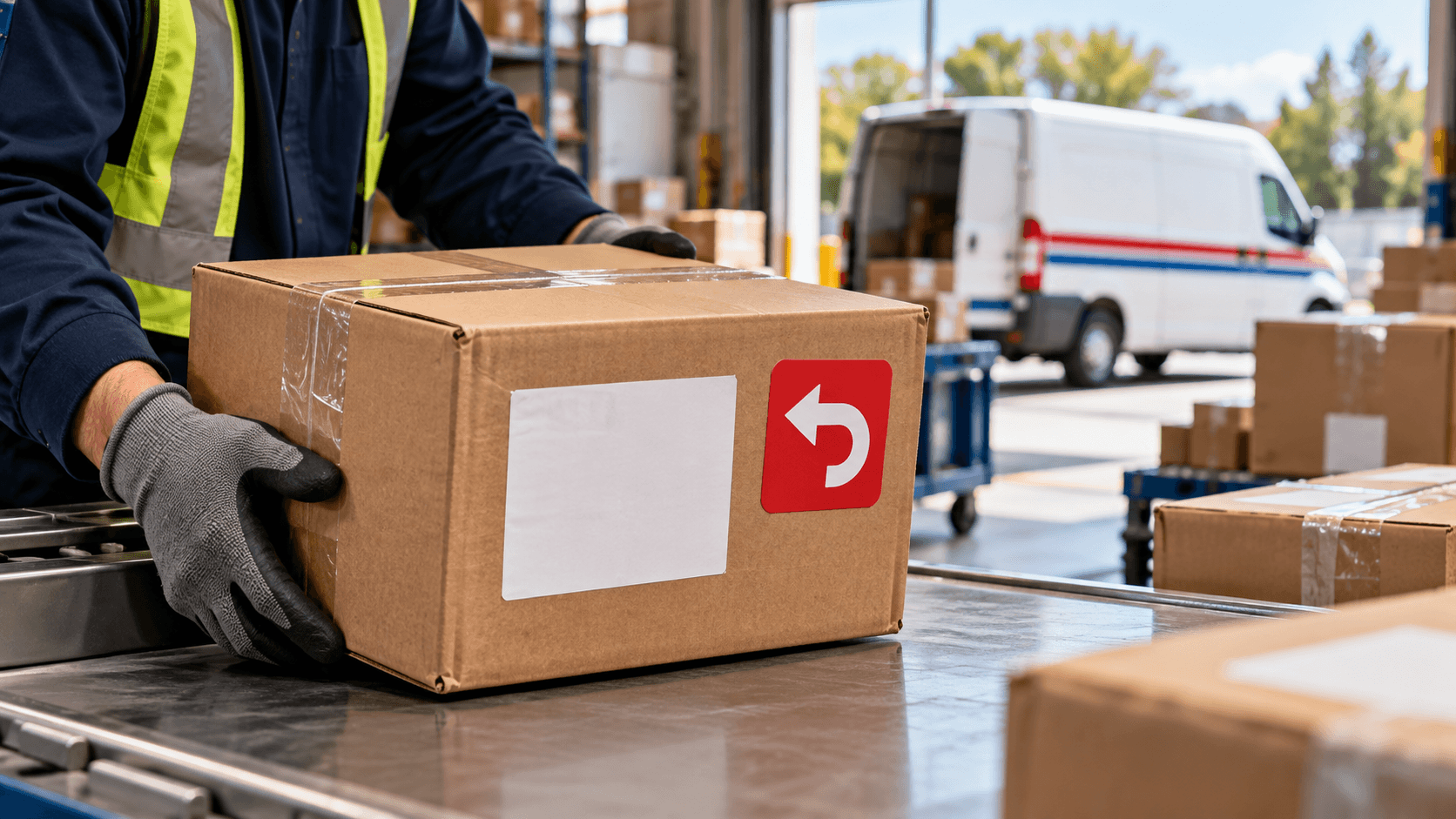
USPS return to origin explained: what it means and who pays
Return to origin means the Postal Service could not deliver a package and is sending it back to the sender. Priority Mail and USPS Ground Advantage come back at no charge; Parcel Select comes back at the Ground Advantage commercial price plus a $6.00 standard fee. The original postage is usually not refunded. The reasons, the costs to a commercial shipper, and how to intercept or prevent a return.
Read it Freight
NMFC lookup and freight class: how to find the right classification
An NMFC item number tells the carrier what the freight is; the freight class tells it how to rate it. The full classification is licensed by the NMFTA through ClassIT+, from $371 a seat a year. How to find your item, how density sets the class for most of them, what a wrong code costs on a FedEx Freight bill, and how to dispute a reclassification within 180 days of the bill.
 Parcel
Zone skipping explained: when it reduces parcel shipping costs
Zone skipping consolidates parcels bound for one region, moves them there as freight, and hands them to a parcel carrier or the Postal Service close to the customer, so each package is priced from a nearby origin. A 5 lb FedEx Ground package lists at $21.69 to zone 8 and $14.06 to zone 2. Whether that $7.63 pays for the truck depends on how many packages share it.
 UPS
UPS and FedEx dimensional weight history: divisors and rule changes, 2007 to 2026
Two kinds of change made dimensional weight what it is: which packages it applies to, and the divisor. The domestic divisor fell from 194 to 166 in January 2011 and to 139 in 2017; Ground packages below three cubic feet became subject to it in December 2014 and January 2015. A dated timeline for both carriers, and what each step did to the same box.
 UPS
UPS and FedEx general rate increase history, 2020 to 2027
UPS and FedEx announced matching general rate increases for seven rate years: 4.9% in 2020 and 2021, 5.9% in 2022, 6.9% in 2023, and 5.9% in 2024, 2025 and 2026. FedEx has announced 5.9% again for January 4, 2027; UPS’s 2027 announcement is pending. Compounding the announced averages gives an illustrative 47.9% since the end of 2019. The year-by-year table, the dates, and why a shipper’s actual increase is rarely the announced average.
 DHL
DHL Fuel Surcharges: How to Check the Percentage and Your Invoice
DHL runs two different fuel surcharges. DHL Express charges a weekly percentage of transportation and related surcharges, 37.50% on exports for October 19 to 25, 2026. DHL eCommerce charges a monthly amount per pound, $0.30 domestic for October 2026. How each is set, and how to check it on an invoice.
 FedEx
FedEx 2027 Rate Changes: Calculate the Impact on Your Shipment Mix
FedEx announced an average 5.9% list rate increase for January 4, 2027, but no shipment moves by the average. Ground rates rise 5.28% to 7.20% by weight and zone, 6.49% on 1 to 5 lb packages, while Express Saver rises 3.09%. A sample mix of 1,000 weekly shipments rises 6.37%. The dated changes, the surcharge table and how to price your own mix.
 UPS
UPS and FedEx minimum net charges: why a bigger discount may not save money
UPS and FedEx agreements bill the greater of your discounted rate or a minimum net charge. On a $20 list package, a 65% discount gives $7, but an $11 minimum bills $11, and a 70% discount still bills $11. How the floor is set, which packages it governs, and why the minimum is often worth more to negotiate than the discount.
 FedEx
FedEx peak season surcharges 2026-2027: dates, rates and the volume-based charge
FedEx 2026-27 demand surcharges run September 28, 2026 to January 17, 2027. Ground Residential and Home Delivery carry $0.50 rising to $0.80 in the peak weeks, Ground Economy $2.55 rising to $4.05, and enterprise shippers over 20,000 residential packages a week pay a volume-based charge of up to $8.00 per ground package.
 Freight
How LTL freight class is determined: density, the NMFC scale and a worked example
For many commodities, LTL freight class comes from density: weight divided by cubic feet, read against the 13-band NMFC scale in effect since July 19, 2025. A worked pallet example shows how 8 inches of height moves the same 400 lb from class 125 to class 100.
 UPS
How UPS and FedEx fuel surcharges are calculated, with a worked example
Carrier fuel surcharges are a weekly percentage set from a published diesel or jet fuel price and applied to the net charge after your discount. How the index tables work, a worked example on a 20 lb zone 6 package, and what to check on an invoice.
 UPS
FedEx and UPS dimensional weight explained: DIM divisors, rounding and packaging
Dimensional weight is length times width times height divided by a divisor, and carriers bill the greater of that and the actual weight. A worked example showing the same 6 lb box billed at 22 lb on a 139 divisor and 19 lb on 166, and why a smaller box usually beats a better divisor.
 Parcel
Effective shipping discount: why you earn less than your headline incentive
The effective discount is what remains of a carrier incentive once minimum charges and undiscounted surcharges are counted. Worked examples on 2026 FedEx list rates show a 55% incentive earning 37.3% on a residential package and 6.0% on a light one, and a 45% agreement beating a 55% one.
 UPS
UPS and FedEx invoice auditing: billing errors, surcharges and refunds
How to audit a UPS or FedEx invoice against your own agreement: the checks that find money, the evidence a dispute needs, and the deadlines. FedEx allows 180 days from the original invoice date on US domestic shipments and 60 days on international ones; UPS allows 180 days from receiving the contested invoice.
 UPS
UPS vs USPS for business shipping: ground rates, fees and volume discounts
No weight threshold decides UPS against USPS, because both carriers have published and negotiated pricing and the fees differ more than the rates. Here is how to reprice your own package mix at both, and what moving volume does to the discounts on what stays.
 FedEx
FedEx Ground Economy (formerly SmartPost): rates, surcharges and how it compares
FedEx Ground Economy is the service FedEx called SmartPost until 2021. Its fee schedule carries no residential delivery charge and no additional handling surcharge, and its delivery area scale stops at $8.80 where FedEx Ground reaches $16.75. Here is how it compares with UPS Ground Saver and USPS Ground Advantage.
 UPS
UPS peak season surcharges 2026-2027: dates, rates and what you will pay
The UPS 2026-27 demand surcharge schedule is in force. Size charges began September 27, per-package service charges begin October 25, and the peak window runs November 22 to December 26. Ground Residential and Ground Saver are $0.50 rising to $0.75, with tiered peak-window rates to $8.00 for qualifying high-volume shippers.
 USPS
USPS holiday price increase 2026: retail and commercial increases
From October 4, 2026 to January 17, 2027, USPS adds $0.40 to $20.80 per package to Priority Mail Express, Priority Mail, Ground Advantage and Parcel Select. Every amount by product, weight and zone, and the 8% April increase it stacks on.
 FedEx
FedEx delivery area surcharge 2027: 2,533 ZIP codes move to Remote
FedEx has published its January 4, 2027 delivery area surcharge ZIP code list and amounts. It moves 2,533 ZIP codes from Extended to Remote, an $8.95 to $12.20 per-package increase at list, and grows the Remote tier by 70%.
 Parcel
Carson Brown Sets Track Record for Second Straight ARCA East Pole at Flat Rock
Carson Brown Locks Down Back-to-Back Poles and a Track Record at Flat Rock Two poles in a row and a new track record. Our driver Carson Brown was fastest again at Flat Rock Speedway.
 UPS
UPS Raises International Air Export Fuel Surcharge Formula
Falling jet fuel prices should have lowered your export costs. Instead, UPS rewrote the math so the same fuel price now carries a higher surcharge. Here is what changed, why it matters, and how to protect your parcel spend before the first invoice lands. UPS revises its International Air-Export fuel surcharge on August 3, 2026.
 UPS
UPS rate increase 2026
UPS Q2 2026 Earnings: What It Means for Parcel Shippers. UPS raised its full year revenue guidance even though it has been shedding package volume. Consequently, the carrier is now earning more from fewer packages, which points to one clear reality. UPS just told parcel shippers exactly what is coming next.
 DHL
DHL Fuel Surcharges Update – Effective Aug 3, 2026
DHL Express will introduce a new Jet Fuel Index on August 3, 2026. The updated index replaces the surcharge table that took effect on April 1, 2026. Unlike many carrier fuel surcharge updates, this change actually reduces costs for parcel shippers.
 FedEx
FedEx Inbound Processing Fee Expands to EU Shipments August 3
FedEx just quietly reshaped the cost of selling into Europe. On the surface, it looks like a simple rename. In practice, it is a brand new fixed charge on every U.S. package headed to the European Union.
 FedEx
FedEx Life Sciences Expansion Reshapes Healthcare Parcel Shipping
Healthcare logistics just entered a new phase. On July 9, 2026, FedEx created FedEx Life Sciences, a standalone organization built to move pharmaceuticals, biologics, medical devices, clinical trial materials, and patient-critical shipments. Rather than treating healthcare as one more vertical, FedEx is now organizing leadership, infrastructure, monitoring, and transportation capacity around it.
Review your agreement before rates change.
Send your agreement for a review of the terms that affect your shipping costs.
Or call 888-356-4421
Free, and no obligation. A written evaluation back inside 48 hours. No fee unless we find documented savings. How we handle your documents
- Your current agreement, any carrier
- One recent invoice, if you have one
- A written evaluation back inside 48 hours