FedEx Didn’t Win With Planes. It Won With a New Definition of Time.
Why the Classic Story Is Incomplete
Most histories say FedEx beat UPS, USPS, and DHL because of airplanes and hubs. That is only half true. The real competition was not between companies. It was between mental models of time.
Three Rivals, Three Operating Logics
UPS: Cost Logic
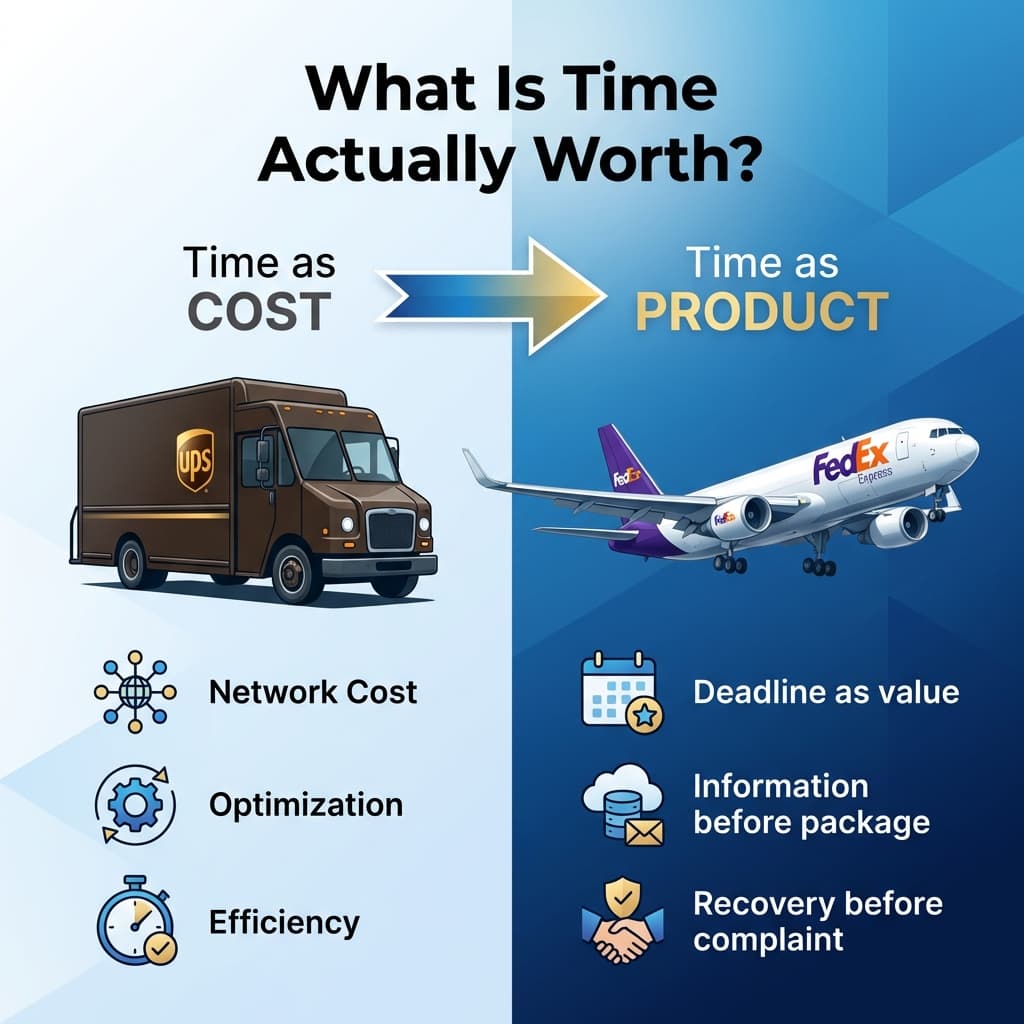
UPS mastered ground efficiency. Routes, density, discipline. Speed was a variable to optimize, not the core product.
USPS: Coverage Logic
Reach mattered more than precision. Every address, every day. Time was flexible because the mission was universal service, not hour specific performance.
DHL: Border Logic
International express first, domestic second. Global before local. Cross border capability was the center of gravity.
Then FedEx Introduced a Fourth Idea
FedEx reframed the unit of value. Not miles. Not weight. Not zones. Tomorrow morning.
Time became the product itself.
FedEx’s Radical Bet: Time as the Product
Fred Smith did not simply add aircraft. He changed what customers were buying. The service was not transportation. The service was certainty, delivered on a deadline.
Three Inventions That Made the Promise Real
1) Hub and Spoke as a Clock
Memphis was not just a location. It functioned like a timing machine. The network synchronized around a fixed nightly rhythm so “overnight” could be engineered, not hoped for.
2) Information Before the Package
COSMOS made visibility part of the service. Tracking was not paperwork. It was operational control and customer confidence.
3) Promise as Brand
“Absolutely, positively overnight” turned operations into trust. The brand was not marketing. It was a public commitment that forced the entire system to behave differently.
Why Competitors Struggled to Copy It
Rivals tried to imitate the assets.
- Buy planes
- Build hubs
- Add tracking
But they were copying hardware while FedEx was running software.
- Decision speed
- Exception recovery
- Frontline autonomy
- Service rituals
The advantage was behavioral, not mechanical.
The Lesson for Today’s Parcel Market
Ecommerce, automation, and AI are creating a new contest of time. Once again, the question is not who has the assets. It is who has the operating philosophy.
What “Speed” Means Now
- Data that travels faster than packages
- Recovery before complaints
- Learning before competitors
The winner will be the company that treats time as a relationship, not a metric.
What This Means for Parcel Shippers
If you only benchmark rates, you miss the real driver of performance. Carrier behavior follows operating philosophy. That philosophy shapes service outcomes, exception handling, and how pricing power shows up in your invoice.
ebb Logistics helps shippers diagnose what is really happening inside carrier networks, then translate it into an actionable strategy. Contract benchmarks. surcharge exposure analysis. lane level performance insights. Recovery playbooks.
Question for You
Which mattered most to FedEx’s rise?
- A) Network design
- B) Information visibility
- C) Cultural commitment to promises
It is hard to separate them. The network enabled the promise. Information protected it. Culture sustained it.
Source of article: Raul Amavisca
ebb Logistics helps parcel shippers by addressing the exact advantage this article explains. Operating philosophy drives outcomes. Not assets.