
FedEx Freight Spinoff 26
The short version
- The FedEx Freight spinoff is exactly the kind of structural shift where strategic guidance pays for itself many times over. We help parcel shippers navigate carrier transitions before they hit the P&L.
- We segment parcel and LTL spend to model the true cost of unbundling, so you know exactly what’s at risk.
- We compare your current rates against the market and identify where discount erosion is most likely.
- We put carriers in direct competition for your volume, then audit performance and surcharges on an ongoing basis.
- Start your contract review Contact ebb Logistics!
ebb Logistics
Insights · May 2026
Carrier Strategy Alert
The bundled FedEx contract is dying. Here’s how to protect your pricing.
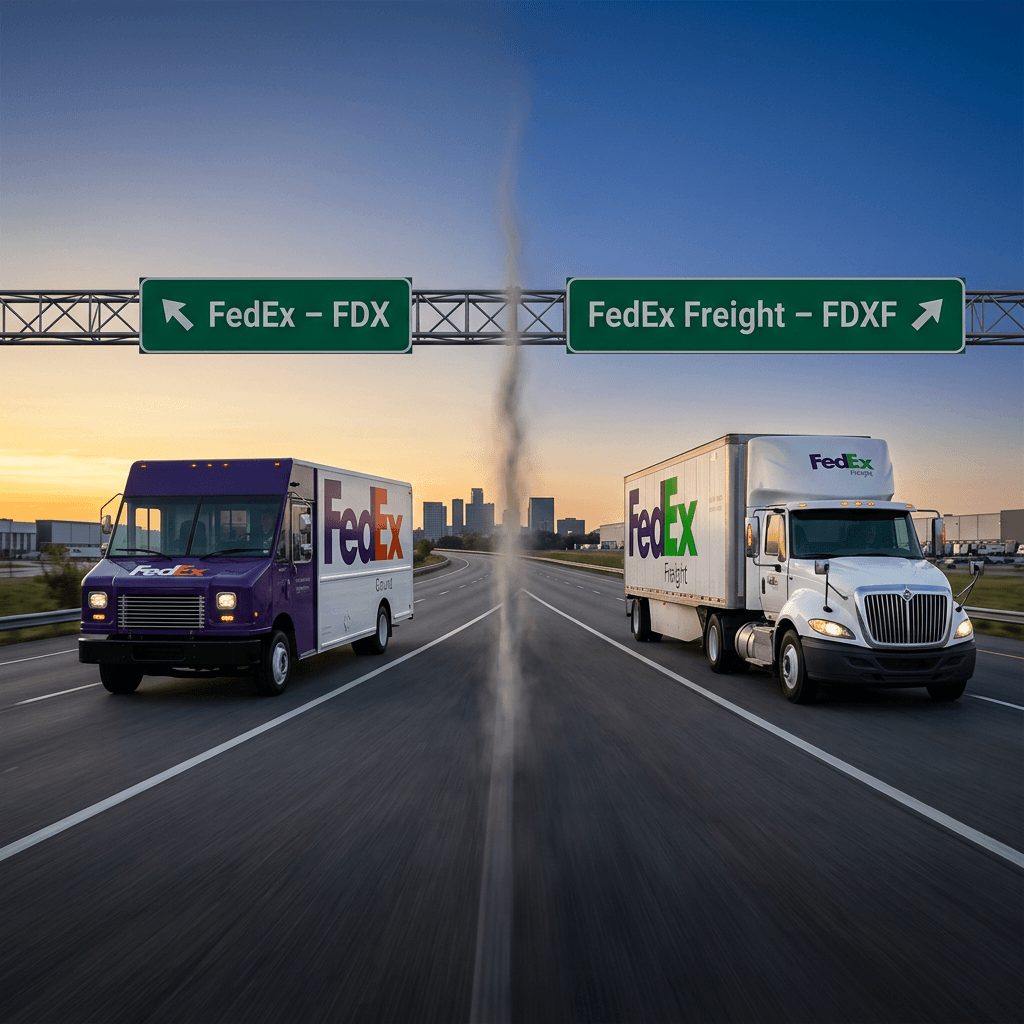
On June 1, 2026, FedEx Freight becomes a standalone public company under the NYSE ticker FDXF. For shippers who built discount tiers on combined parcel-and-LTL spend, the math is about to change.
What’s actually happening
FedEx’s board has officially approved the spinoff of FedEx Freight, with trading set to begin June 1, 2026. Shareholders of record as of May 15 will receive one FDXF share for every two FDX shares held. FedEx will retain a 19.9% stake, which it plans to divest within 24 months. Before separation, FedEx Freight will pay a $4.1 billion cash dividend to FedEx.
As a standalone company, FedEx Freight will operate as a pure-play LTL carrier, competing head-to-head with Old Dominion, XPO, and Saia. Most importantly for shippers, bundled parcel-plus-LTL pricing programs are being dismantled in the lead-up to the split.
Five inflection points shippers cannot afford to ignore.
Why this changes everything
FedEx Freight is projecting $8.7 billion in revenue and a 12% operating margin for 2026. Leadership has guided medium-term revenue growth of 4% to 6% and core profit growth of 10% to 12%. Translation: the new entity will prioritize margin expansion, network density, and pricing discipline. To support the transition, FedEx is investing $600 million in IT infrastructure and doubling its dedicated LTL sales force to 400 reps before separation.
The strategic logic is clear. Express, Ground, and Freight serve different markets with different cost structures and capital needs. As independent companies, both can sharpen commercial focus and chase peer valuations. However, that same logic eliminates the financial incentive to subsidize parcel rates with LTL spend, or vice versa.
Consequently, FedEx is already renegotiating bundled agreements, starting with customers carrying significant LTL volume. The financial scaffolding of the integrated discount tier is being pulled out, one contract at a time.
The structural change driving every conversation between now and June 1.
What it means for parcel shippers
The most immediate risk is discount erosion. If your earned discount tier was built on combined parcel and LTL spend, that leverage disappears when the contracts split. FedEx’s broader discounting push is already softening as surcharges continue climbing. Shippers without a renegotiation strategy could see effective rates rise even without a general rate increase. Speaking of which, FedEx Freight implemented a 5.9% GRI in January, signaling the new entity’s pricing posture.
Service strategy is also shifting. As a pure-play LTL carrier, FedEx Freight will optimize for network efficiency, not bundled customer retention. Parcel shippers can no longer assume LTL volume protects their parcel pricing, or that parcel loyalty earns LTL flexibility.
But the unbundling also creates real leverage. Independent contracts mean independent competition. Shippers can now run separate RFPs, benchmark FedEx Freight against ODFL, XPO, and Saia, and put parcel against UPS, regional carriers, and USPS-injection providers. The shippers who segment their spend, benchmark aggressively, and diversify carriers will win this transition. Those who wait will absorb whatever pricing structure FedEx hands them.
The same event is a threat or an advantage. Timing decides which.
Key takeaways
Turn this transition into a competitive advantage
The FedEx Freight spinoff is exactly the kind of structural shift where strategic guidance pays for itself many times over. We help parcel shippers navigate carrier transitions before they hit the P&L.
We segment parcel and LTL spend to model the true cost of unbundling, so you know exactly what’s at risk.
We compare your current rates against the market and identify where discount erosion is most likely.
We put carriers in direct competition for your volume, then audit performance and surcharges on an ongoing basis.