
UPS Bets $100M on RFID. Shippers Should Pay Attention.
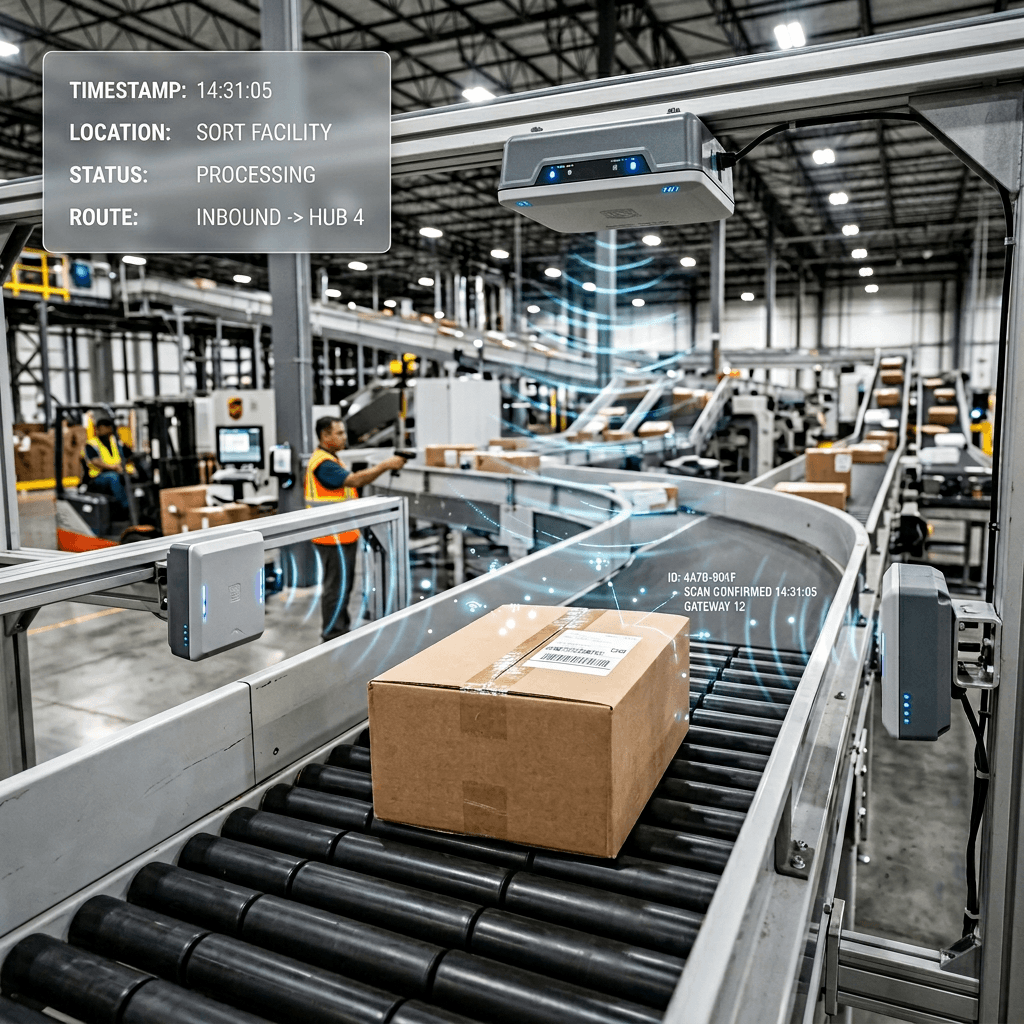
UPS has deployed RFID technology across its entire U.S. network. The carrier installed sensors in every delivery truck, sortation facility, and UPS Store. The investment totals roughly $100 million and removes an estimated 20 million manual scans per day from its operations.
Source: UPS Press Release
This makes UPS the first major parcel carrier to run RFID at full network scale. Barcodes are not gone, but they are no longer the primary tracking mechanism inside the UPS system. Packages are now read automatically as they move through the network.
Three forces drove the timing. Passive UHF tag costs fell under three cents per unit at volume. Parcel volumes finally reached a level where per-package RFID pays back. And shipper expectations for Amazon-grade visibility pushed every legacy carrier to act. FedEx, USPS, and Amazon Logistics have not matched this deployment. That gap is the strategic point.
What This Means for Parcel Shippers
- Visibility becomes a competitive wedge. UPS will market real-time, scan-free tracking as a premium service attribute. Expect that capability to show up in RFP language, service guarantees, and contract commitments over the next 12 to 24 months.
- Labor cost removal changes the margin conversation. UPS eliminated a large manual scanning workload. That creates room for the carrier to defend rates, invest in further automation, or fund incentives for high-value accounts. Shippers should not assume the savings flow through to base rates automatically.
- Lock-in risk rises. UPS wants multi-year commitments tied to its visibility advantage. Signing long contracts right now, before FedEx and USPS respond, may leave shippers paying a premium for a feature that becomes table stakes within 24 months.
- Surcharge and accessorial exposure does not shrink. Network modernization does not change how carriers price DIM weight, residential delivery, peak, fuel, or address corrections. Those line items remain the single biggest driver of effective cost per package.
- Data quality improves on the carrier side. Shippers should expect cleaner tracking events, fewer lost-in-transit claims, and better exception reporting. That creates a real opportunity to tighten SLAs and hold carriers accountable to measurable performance.
What Shippers Should Do Next
- Audit your current UPS contract against the new capability set. If visibility guarantees are not written in, they are not enforceable. Push for contractual SLAs on scan accuracy, exception notification timing, and delivery confirmation.
- Resist long-term exclusivity. Keep contract terms flexible enough to capture rate and service gains when FedEx and USPS close the technology gap. One- to two-year terms with defined out clauses protect optionality.
- Re-benchmark your rates now. Carrier investment in automation is a leverage point in negotiation, not a reason to accept higher pricing. Compare your effective cost per package across carriers, lanes, and service levels using current market data, not last year’s numbers.
- Pressure-test surcharge exposure. Run a 12-month analysis of accessorials as a percentage of total spend. Identify the top three cost drivers and build mitigation into packaging, address validation, and service-level selection.
- Diversify carrier mix where the lane economics support it. Regional carriers, USPS for lightweight residential, and Amazon Logistics for specific geographies can offset concentration risk and create rate leverage in UPS negotiations.
- Validate data internally. If your TMS or parcel platform cannot ingest and act on richer tracking events, the carrier’s technology upgrade delivers no value on your side. Close that gap before the next contract cycle.
How ebb Logistics Can Help
ebb Logistics operates as an independent advisor to parcel shippers. We do not resell carrier services, so our analysis is not tied to carrier incentives.
Our capabilities align directly with the decisions this announcement triggers. We benchmark contracts against current market pricing using shipper-specific lane, weight, and service profiles. We model surcharge exposure and identify the specific accessorials driving effective rate inflation. We support contract negotiation with data that reflects what comparable shippers actually pay, not list rates.
We also run parcel invoice audits to recover billing errors and validate service performance against contracted SLAs. For shippers evaluating a multi-carrier strategy, we build the financial and operational case for diversification, including regional carrier integration and service-level optimization.
The carrier landscape is moving. Shippers who treat this as a procurement-cycle event, rather than a routine renewal, will capture the pricing and service leverage. We help make that case with data.