
FedEx July 20 Surcharge Changes
|
||||||||||||
Carrier Alert • Effective July 20, 2026 FedEx Is Changing Its Surcharge Rules. Here Is How to Protect Your Margin. |
||||||||||||
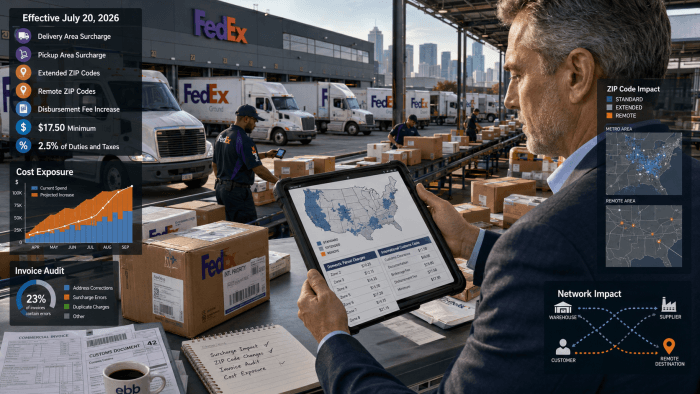
On July 20, 2026, FedEx will replace the ZIP code lists that drive its Delivery Area and Pickup Area Surcharges. Meanwhile, the international Disbursement Fee will climb as well. Notably, none of this shows up as a headline rate increase. As a result, your base transportation rates can stay flat while your actual invoices rise. Furthermore, the change is now only days away, so the window to measure exposure and update your rating systems is closing fast. |
||||||||||||
|
||||||||||||
Delivery ZIP Changes Can Rewrite Package EconomicsFedEx applies six Delivery Area Surcharge classifications across U.S. package services, covering contiguous, extended, remote, Alaska, Hawaii, and intra-Hawaii destinations. Because the destination ZIP alone decides which fee applies, a single reclassification changes the cost of every shipment entering that ZIP. For context, the 2026 residential surcharge runs $6.60 per package, extended residential runs $8.80, and remote reaches $16.75. Alaska climbs to $46, while Hawaii sits at $16.25. In addition, fuel surcharges may stack on top, though your contract discounts may soften the final figure. Consequently, the right measure is volume, not the raw count of changed ZIP codes. One remote reclassification on a high-traffic lane outweighs dozens of changes in areas you rarely ship to. |
||||||||||||
Pickup ZIP Codes Open a Second Cost PathUnlike delivery fees, Pickup Area Surcharges follow the collection location, not the customer. Currently these run $6.20, $8.30, and $15.50 per stop, depending on the pickup ZIP classification. Moreover, residential pickup points can draw a separate $5.95 charge, and fuel surcharges may lift the total further. Therefore, review every place FedEx collects from, not just your primary distribution center. Specifically, check warehouses, retail stores, suppliers, vendors, returns centers, temporary facilities, and third-party logistics sites. Otherwise, a single supplier pickup change can raise your costs even when nothing about the customer destination moves. |
||||||||||||
ZIP Monitoring Becomes an Ongoing ControlImportantly, FedEx states that it may revise these ZIP lists without notice and as often as it chooses. As a result, ZIP monitoring is no longer an annual project. Instead, it becomes a standing control that protects your rating accuracy month after month. In practice, store the effective date alongside every ZIP surcharge table you keep. Otherwise, historical reports can quietly drift out of date and distort your forecasting and invoice audits. With effective dates attached, however, you preserve clean rating, reliable projections, and defensible audits. |
||||||||||||
International Disbursement Fees Climb for ImportersFedEx charges the Disbursement Fee whenever it advances duties, taxes, and merchandise processing fees on your behalf. Today the fee equals the greater of $15 or 2 percent. On July 20, however, it becomes the greater of $17.50 or 2.5 percent. Accordingly, the minimum rises 16.7 percent, and the percentage-based charge rises 25 percent. To illustrate, a shipment carrying $1,000 in government charges moves from $20 to $25. In addition, the point where the percentage overtakes the minimum drops from $750 to $700. Consequently, more entries land in percentage territory, so importers should refresh landed-cost models, margin assumptions, and customer pricing now. |
||||||||||||
|
||||||||||||
Your Pre July 20 ChecklistTo move quickly, work through these steps in order. Each one turns the announcement into a number you can act on.
|
||||||||||||
|
||||||||||||
Ultimately, quantified exposure becomes leverage. With hard numbers in hand, you can push for stronger discounts, surcharge caps, or remote-area protections. In parallel, you can test regional and postal alternatives for concentrated remote ZIP clusters, provided each option clears your cost, service, and coverage checks. |
||||||||||||
|
||||||||||||
Quick Recap» FedEx swaps its delivery and pickup ZIP lists on July 20. » A residential to remote move adds $10.15 per package. » Pickup exposure spans suppliers, stores, returns sites, and 3PLs. » Disbursement fees rise 16.7 percent at the floor and 25 percent on the rate. » Volume-weighted analysis beats counting changed ZIP codes. | ||||||||||||
|
Source: FedEx rate changes and surcharge details, published by FedEx. See | ||||||||||||