GOFO 2026 Expansion Signals More Last-Mile Competition for Parcel Shippers
The short version
- GOFO plans more than 50 new U.S. delivery stations in 2026.
- Automation upgrades are planned across 13 major hubs.
- GOFO expects coverage to exceed 12,000 ZIP Codes before peak season.
- The company is preparing market entry in Canada.
- Its no-surcharge policy may pressure traditional pricing models.
Last-mile delivery is becoming more competitive, automated, and data-driven. GOFO’s 2026 expansion plan signals a larger shift in parcel strategy. Regional and alternative carriers are building denser networks, adding automation, and targeting cost-sensitive shippers. For parcel shippers, this creates new leverage. It also raises new questions about service reliability, coverage fit, and carrier diversification.
GOFO announced its 2026 North American expansion plan in early April. The plan includes automation upgrades at 13 primary and secondary hubs. It also includes more than 50 new U.S. delivery stations. GOFO expects to expand coverage to more than 12,000 U.S. ZIP Codes before peak season. The company is also entering Canada, with hub development underway in Toronto and Vancouver. GOFO says it will maintain a no-surcharge policy through 2026.
Source: GOFO
Analysis
GOFO’s announcement is not just a capacity update. It is a signal about where parcel competition is moving. The company is using automation, network intelligence, and station density to support growth. This matters because parcel carriers are under pressure to improve service while protecting margin.
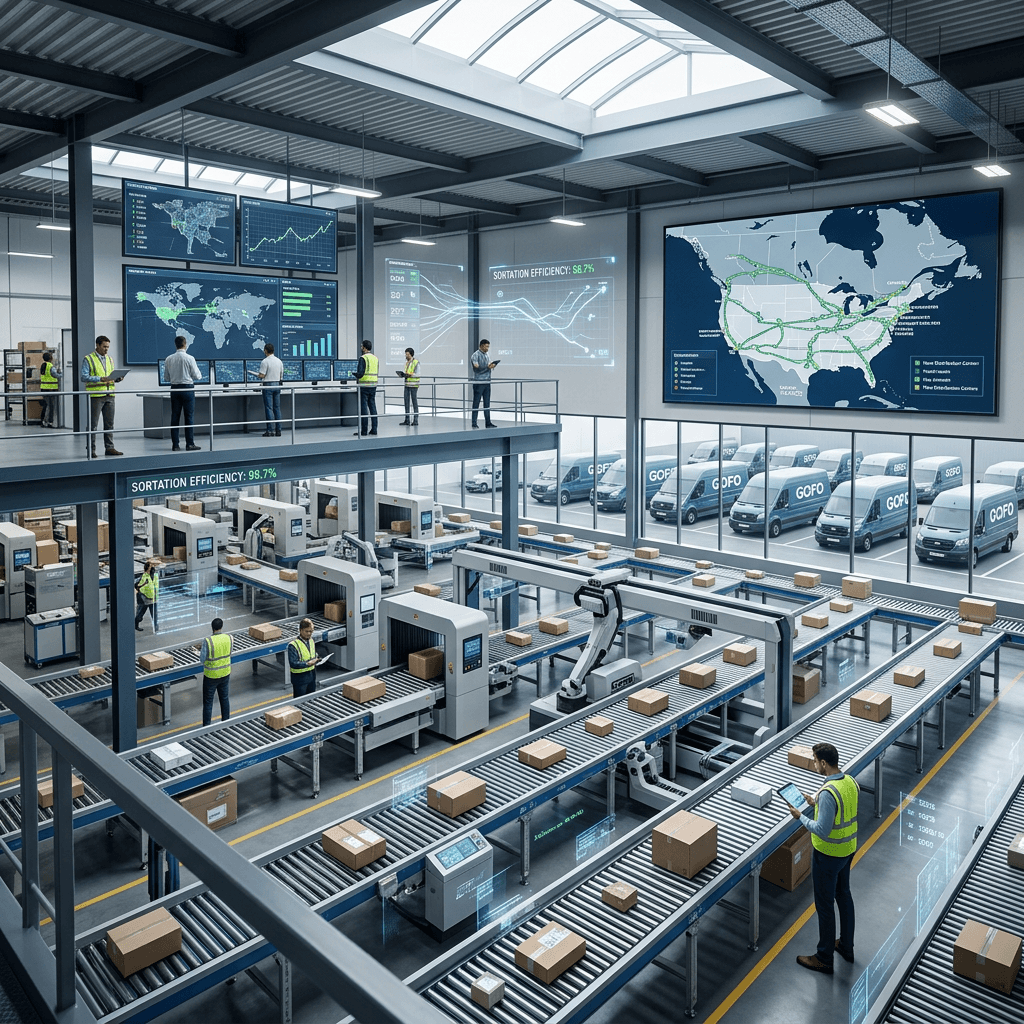
At the hub level, GOFO plans automation upgrades across 13 primary and secondary hubs. These facilities will use double-loop cross-belt and narrow-belt sortation systems. GOFO expects these hubs to process about 20,000 to 45,000 parcels per hour. Each system can sort to about 400 to 600 chutes.
This matters because automation can reduce handling costs. It can also reduce dwell time and improve sort accuracy. For shippers, those operational gains can support better transit consistency. However, performance still depends on execution by lane, ZIP Code, and facility.
At the station level, GOFO plans to add more than 50 delivery stations in 2026. The company already operates more than 140 hubs and stations across the country. It also plans broader use of modular automated sortation. GOFO says that deployment should support 50% of station sort volume nationwide.
The technology layer is also important. GOFO ATLAS integrates order, warehouse, and transportation systems. The platform supports visibility, dispatch orchestration, routing optimization, and exception management. That positions GOFO as a technology-driven last-mile network, not only a delivery provider.
Coverage is expanding quickly. GOFO says it now reaches 47 states, more than 9,200 ZIP Codes, and over 70% of the U.S. population. Before peak season, it expects to reach more than 12,000 ZIP Codes and over 80% of the U.S. population.
The strongest strategic signal is GOFO’s no-surcharge policy through 2026. Many parcel shippers are absorbing higher accessorial costs, fuel changes, demand surcharges, and compliance fees. A no-surcharge offer can create negotiation pressure on legacy carriers. It can also help shippers test alternative last-mile capacity.
Map of GOFO’s U.S. hub network, including super, primary, and secondary hubs
Impact on Parcel Shippers
GOFO’s expansion gives parcel shippers another carrier option to evaluate. This is especially relevant for e-commerce, retail, marketplace, and high-volume residential delivery networks.
However, shippers should avoid viewing coverage as the only requirement. ZIP Code reach does not always equal lane-level reliability. Shippers need to compare cost, transit performance, claims experience, scan visibility, delivery quality, and exception handling.
The no-surcharge policy may create cost advantages in specific profiles. It can reduce exposure to unpredictable accessorial growth. Still, shippers should model total landed cost. Base rates, minimum charges, dimensional rules, delivery areas, and service failures all affect the final outcome.
The larger takeaway is leverage. More credible delivery options can improve carrier negotiations. Shippers can use alternative carriers to reduce dependency on UPS, FedEx, USPS, and regional incumbents. But they need data before moving volume.
GOFO may not fit every shipper. It may fit specific zones, service levels, residential profiles, or cost-sensitive segments. The right approach is controlled testing, not full network disruption.
How ebb Logistics Can Help
ebb Logistics helps shippers evaluate carrier options with data, not assumptions. We analyze shipment history, carrier agreements, surcharge exposure, service performance, and ZIP Code coverage.
For GOFO and other alternative carriers, we help determine where the network fits. That includes lane modeling, cost comparisons, service risk, and implementation planning.
We also help shippers protect leverage during negotiations. Alternative carrier options can create pressure, but only when backed by credible volume modeling. ebb Logistics turns carrier expansion news into practical shipping strategy.
If your parcel network depends too heavily on one or two carriers, now is the time to review your options. ebb Logistics can help identify savings, reduce surcharge exposure, and build a stronger carrier strategy.