
UPS International Air Fuel Surcharge Increase Raises Costs for Global Parcel Shippers
The short version
- UPS will raise International Air Export and Import fuel surcharges on May 11, 2026.
- Both export and import tables increase by 2.00 percentage points.
- UPS is keeping the existing fuel tier structure.
- Import rates remain 3.75 percentage points higher than export rates.
- International air shippers should update cost models immediately.
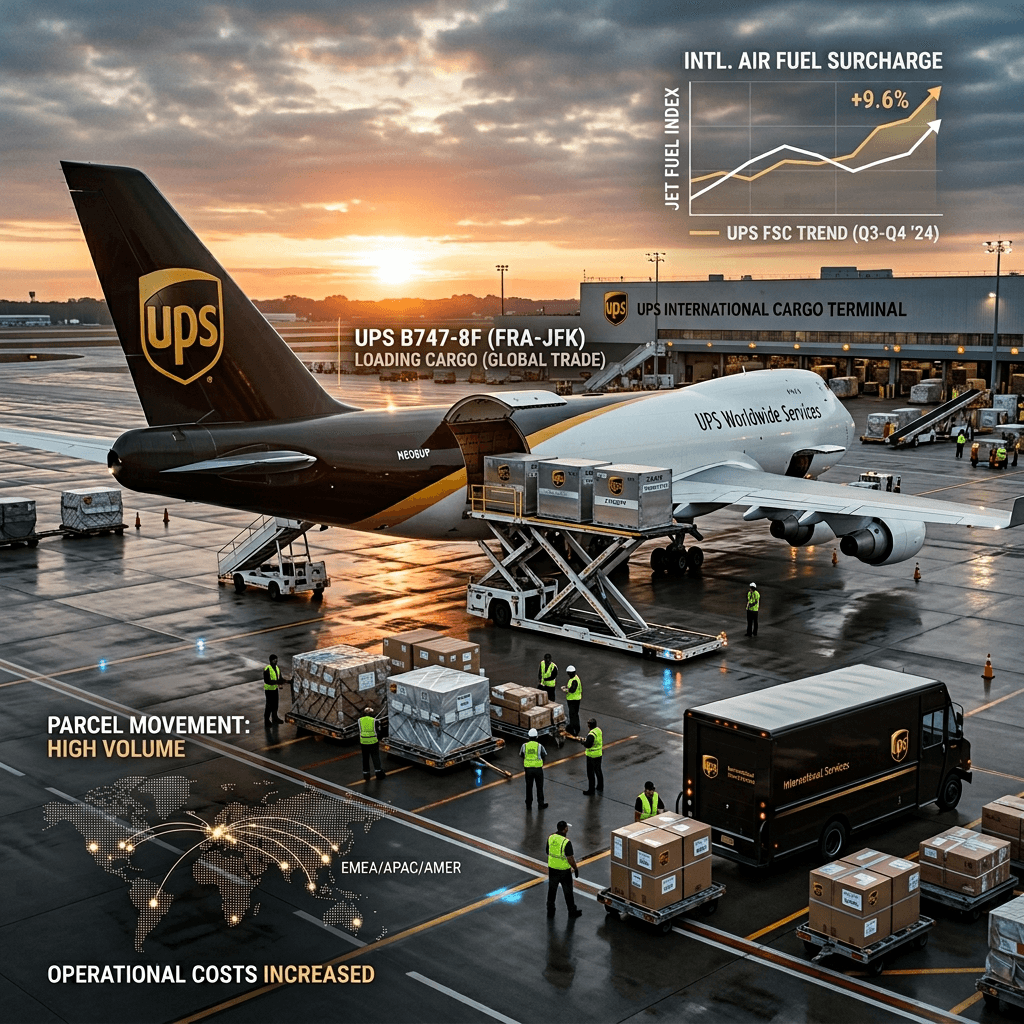
UPS is increasing international air fuel surcharges again, effective May 11, 2026. The change adds a flat 2.00 percentage point increase across the applicable International Air Export and International Air Import fuel surcharge tables.
UPS is not changing the surcharge structure, fuel tiers, pricing increments, or step logic. It is increasing the cost layer applied to covered international air shipments.
For parcel shippers, the impact is immediate. Export and import costs will rise, landed-cost models will need updates, and surcharge exposure will require closer review. This is another signal that shippers cannot manage international parcel spend by base rates alone. Carrier benchmarking, surcharge auditing, and contract strategy now matter more than ever.
Source: UPS
UPS is not changing the structure. It is increasing the cost layer applied to international air shipments.
The Details
The UPS update is direct and measurable. Export surcharge rates move from 36.25% to 39.75% into a new range of 38.50% to 41.50%. Import surcharge rates move from 40.00% to 43.50% into a new range of 42.25% to 45.25%.
This is not a complex structural change. UPS is keeping the $0.04 fuel price increments. It is also keeping the 0.25% step between tiers. That means the underlying table logic remains familiar. However, every applicable tier now carries higher cost exposure.
The import and export gap also stays consistent. Import rates remain 3.75 percentage points higher than export rates. That matters because UPS is not widening the spread between inbound and outbound shipments. Instead, it is raising both sides together.
This creates a clean cost increase for international air users. Shippers should not treat this as a fuel-market adjustment only. It is also a pricing action that increases UPS revenue per shipment. That matters for any shipper moving cross-border parcel volume.
The timing also matters. The change comes during a period of growing surcharge activity across major parcel carriers. Fuel, demand, handling, and compliance fees continue to expand. As a result, base rates tell only part of the cost story.
Impact on Parcel Shippers
The biggest impact is cost accuracy. Any model using the prior UPS surcharge table will understate international air costs after May 11, 2026. That affects budgets, customer pricing, margin analysis, and landed-cost projections.
Next, this update affects carrier strategy. Shippers using UPS Worldwide Express, Worldwide Saver, Worldwide Expedited, Worldwide Express Freight, and related services should review lane-level impact. High-weight shipments will feel the increase faster because fuel surcharges apply against transportation charges.
The change also affects contract leverage. Many shippers negotiate discounts on base transportation rates. However, surcharge exposure can erase part of that value. If fuel terms remain uncapped or weakly controlled, real savings may fall short.
Additionally, finance and logistics teams need alignment. Finance teams should update forecasts. Logistics teams should review shipment profiles. Sales teams may need to adjust pricing assumptions for international customers.
Finally, this reinforces a larger point. Parcel cost management now requires total-cost visibility. Shippers need to measure base rates, fuel, accessorials, dimensional charges, and service performance together.
How ebb Logistics Can Help
ebb Logistics helps parcel shippers understand the full financial impact of carrier surcharge changes. We do more than review base rates. We analyze total parcel spend, surcharge exposure, service usage, and contract terms.
Our team can model the UPS fuel surcharge increase against your actual shipment data. This shows where the increase hits hardest. It also helps identify lanes, services, and shipment profiles with the highest risk.
ebb Logistics also benchmarks your agreement against current market conditions. That gives your team stronger negotiation leverage. It also helps protect savings from fuel, accessorial, and compliance-related cost increases.
If your international air costs are rising, now is the time to review the data. ebb Logistics can help you reduce exposure, improve carrier strategy, and protect margin.