
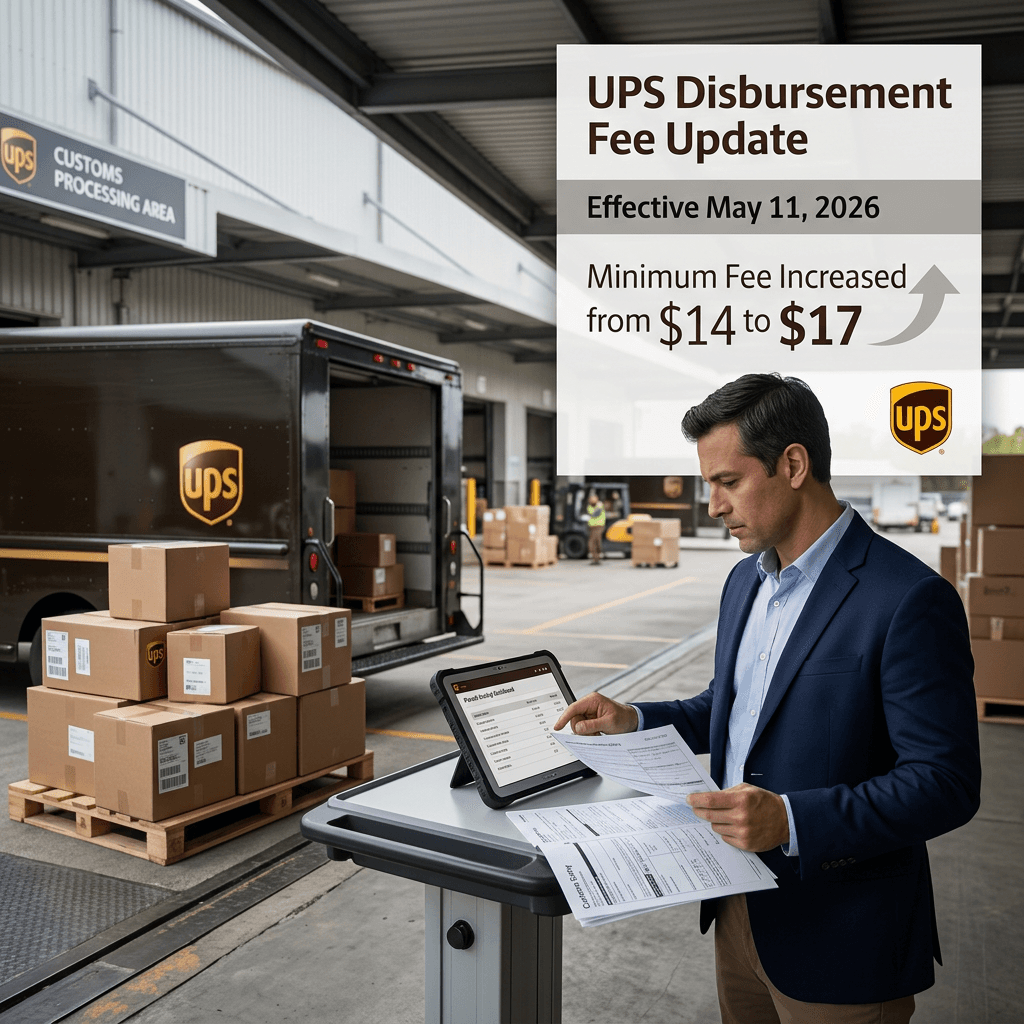
UPS Disbursement Fee Increase Update
The short version
- UPS Disbursement Fee minimum rises from $14.00 to $17.00 on May 11, 2026
- Shipments below $850 in duties and taxes are the affected segment
- Each affected shipment costs $3.00 more, a 21.4% jump
- High-volume importers of lower-value goods face the greatest exposure
- Landed-cost models, contracts, and brokerage strategies all warrant a fresh look
What UPS International Shippers Need to Know Before May 11, 2026
A small fee change. A big budget impact. Here’s what to do before it hits your invoices.
Read time: 5 min
Category: International Shipping
Effective May 11, 2026, UPS is raising the minimum Disbursement Fee from $14.00 to $17.00 per applicable shipment. The 2% rate on duties and taxes stays the same, but the new floor will quietly push up costs on thousands of lower-value international shipments.
If your business imports goods through UPS, this update deserves a closer look before it starts showing up on your invoices.
What’s Changing at a Glance
| Component | Before May 11 | After May 11 |
|---|---|---|
| Disbursement Fee Rate | 2% of duties & taxes | 2% of duties & taxes |
| Minimum Fee | $14.00 | $17.00 |
| Break-Even Threshold | $700 in duties & taxes | $850 in duties & taxes |
| Per-Shipment Increase | +$3.00 (21.4%) |
The fee applies whenever UPS pays or processes duties and taxes on your behalf. It covers UPS international package services and UPS Worldwide Express Freight services for U.S. 48, Alaska, and Hawaii customs brokerage.
Why This Matters More Than It Looks
This isn’t a rate increase, it’s a minimum-fee increase. That distinction is important.
Shipments with more than $850 in duties and taxes are unaffected. The 2% calculation already exceeds the new floor, so nothing changes.
Shipments with less than $850 in duties and taxes are where the cost lands. For these packages, UPS will now charge the $17 minimum instead of the smaller percentage-based fee.
A Real-World Example
That’s 21.4% more for a single fee line item. Now multiply that across volume:
For high-frequency importers of lower-value goods, this fee change can quietly erase margin you worked hard to negotiate elsewhere.
Who Is Most Exposed?
You should pay close attention if your business fits any of these profiles:
Importing lower-value SKUs from international suppliers.
Many small shipments rather than fewer large ones.
Shipments routinely fall under the new threshold.
You rely on UPS for customs brokerage rather than handling it independently.
The Bigger Trend: Death by a Thousand Accessorials
This update reinforces a pattern we see across every major carrier. Base transportation rates capture the headlines, but the real margin compression is happening in the fee mechanics, minimums, accessorials, surcharges, and brokerage charges.
Shippers who only negotiate transportation discounts are leaving money on the table. The shippers winning today are the ones who:
- Audit accessorial exposure regularly
- Build true landed-cost models that include carrier fee minimums
- Push for fee floor protections in their contracts
- Treat customs brokerage as a negotiable line, not a fixed cost
Your Action Plan Before May 11
Here’s what we recommend doing right now:
- Pull your last 90 days of UPS international invoices
Identify how often the Disbursement Fee appears and what duty/tax amounts triggered it. - Flag every shipment under $850 in duties and taxes
These are your exposure points. Quantify how many you process monthly. - Calculate your projected cost increase
Multiply your monthly affected shipment count by $3.00. Annualize it. That’s your real budget impact. - Update your landed-cost models
If your pricing or margin models don’t include brokerage fees and carrier minimums, they’re understating true cost. - Review your UPS contract language
Check for fee floor protections, surcharge caps, or brokerage rate carve-outs. If absent, this is a negotiation opportunity. - Audit alternative customs brokerage options
For high-volume importers, third-party brokerage can sometimes deliver lower total cost than carrier-bundled brokerage.
Key Takeaways
- UPS Disbursement Fee minimum rises from $14.00 to $17.00 on May 11, 2026
- The 2% rate is unchanged
- Shipments below $850 in duties and taxes are the affected segment
- Each affected shipment costs $3.00 more, a 21.4% jump
- High-volume importers of lower-value goods face the greatest exposure
- Landed-cost models, contracts, and brokerage strategies all warrant a fresh look
How ebb Logistics Can Help
At ebb Logistics, we help parcel shippers turn carrier updates like this into real, measurable savings. Our team can:
- Analyze your invoice data to quantify exact exposure to the new Disbursement Fee minimum.
- Model the cost impact across your full shipment history and forecast forward.
- Benchmark your UPS agreement against current market terms, surcharge language, brokerage fees, and minimum charges.
- Build negotiation strategy that addresses fee floors, accessorial protections, and total landed cost, not just transportation discounts.
- Strengthen billing controls so unexpected fee changes don’t quietly inflate your spend.
Carrier updates rarely arrive in your favor. But with the right data and the right strategy, you can make sure they don’t catch you off guard.
Ready to See Your Exposure?
If UPS is part of your international parcel mix, now is the time to act. Get a complimentary review of your UPS Disbursement Fee exposure, we’ll show you exactly where the May 11 change will hit your invoices.