Zone skipping explained: when it reduces parcel shipping costs
The short version
- Parcel prices rise with zone, and zone is distance from the origin. Zone skipping moves the origin closer to the customer by carrying the packages most of the way as freight.
- The saving per package is the price difference between the long zone and the short one, after your discounts. The cost per package is the linehaul and handling divided by the packages on the truck.
- Volume matters per departure, not per year. Waiting a week to fill a truck saves money and costs a week of delivery time.
- The terms overlap. One common model enters parcels at a USPS facility in the destination network, where Parcel Select destination-entry prices do not vary by zone.
- A business with one warehouse can zone skip. It needs enough orders to one distant region to cover a regular linehaul, its own or shared with other shippers.
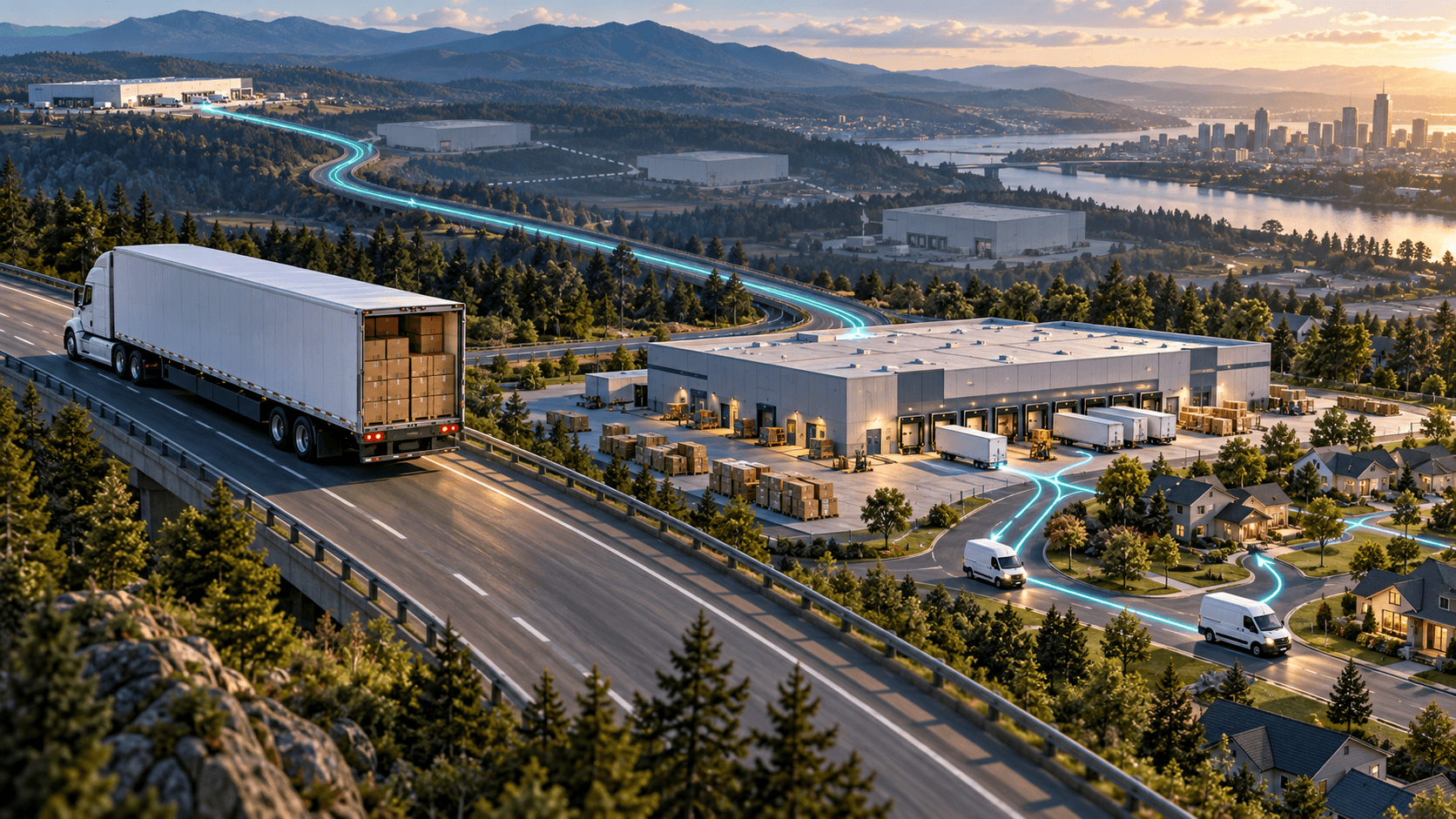
Zone skipping is a way of shipping parcels in which a shipper consolidates packages bound for one region, moves them there in bulk on a truck, and hands them to a parcel carrier or the Postal Service close to the customers. Each package is then priced from that nearby point instead of from the warehouse, so it travels the last part of the journey at a low zone instead of crossing the country at the highest one. At FedEx Ground 2026 list rates, a 5 lb package costs $21.69 to zone 8 and $14.06 to zone 2, a difference of $7.63. Zone skipping reduces cost when that difference, after your discounts, is larger than the truck and handling cost per package, which comes down to how many packages share each truck.
How zone skipping works
UPS and FedEx price ground packages by zone, which is set by the distance between the origin and destination ZIP codes. Zone 2 covers roughly the first 150 miles, zone 5 up to about 1,000 and zone 8 everything beyond 1,800 miles. A package from New Jersey to Los Angeles is zone 8. The same package handed to a carrier in Southern California for delivery in Los Angeles is zone 2. Our zone map shows the bands from any origin.
A zone skipping move has four steps:
- Sort. At the warehouse, packages are labelled as usual and sorted by destination region.
- Consolidate. Packages for one region are stacked on pallets or floor loaded into a trailer.
- Linehaul. The trailer travels as freight, truckload or LTL, to a point inside the destination region.
- Induct. The packages are handed to a parcel carrier’s hub or a postal facility there, and travel the last leg as ordinary parcels.
With UPS and FedEx, the zone is calculated from the origin the carrier has for the shipment, so tendering at a distant hub only lowers the zone if your account is set up to ship from there and the labels carry that origin. That is an operational and contractual arrangement to agree with the carrier in writing before the first trailer leaves, not something a shipper can do by driving packages to another terminal.
Zone skipping vs direct injection
The terms are often used interchangeably, and neither has a single fixed definition. What differs in practice is the operating model: where the packages enter and how they are priced. Two common models:
| Induction to a parcel carrier | Destination entry with USPS | |
|---|---|---|
| Where the packages enter | A UPS, FedEx or regional carrier hub inside the destination region | The USPS facility that serves the delivery address: a sectional center facility (DSCF), destination hub (DHub) or delivery unit (DDU) |
| How they are priced | The carrier’s normal zone rates, from the nearer origin | Parcel Select destination-entry prices, by weight only, with no zone |
| What the shipper or its partner must do | Arrange the account and origin with the carrier | Prepare and manifest under USPS commercial rules and deposit the parcels at the right facility |
USPS entry levels and weight-only pricing from Notice 123, effective October 4, 2026.
Destination entry bypasses part of the upstream postal network, and how much depends on the entry level. A parcel entered at the delivery unit (DDU) goes straight onto a carrier’s route; one entered at a sectional center facility or destination hub is still sorted and carried on to the delivery unit. Each level is priced for the work it leaves to the Postal Service, which is why DDU prices are the lowest and why the parcels must be presented at a facility that serves their addresses.
How much zone skipping saves per package
The saving is the gap between the zone the package would have travelled and the zone, or entry price, it travels instead. At published prices:
| Package | FedEx Ground zone 8 | FedEx Ground zone 2 | Transportation difference, before linehaul and handling |
|---|---|---|---|
| 3 lb | $19.11 | $13.30 | $5.81 |
| 5 lb | $21.69 | $14.06 | $7.63 |
| 10 lb | $26.38 | $15.85 | $10.53 |
| 20 lb | $43.52 | $19.36 | $24.16 |
FedEx Standard List Rates, FedEx Ground, effective January 5, 2026, before fuel, residential and other surcharges.
| Package | Ground Advantage commercial, zone 8 | Parcel Select DSCF | Parcel Select DDU | Postage difference, zone 8 to DSCF, before linehaul and handling |
|---|---|---|---|---|
| 5 lb | $20.24 | $8.30 | $7.70 | $11.94 |
| 10 lb | $26.39 | $10.40 | $9.92 | $15.99 |
USPS Notice 123, effective October 4, 2026, including the holiday adjustment that applies until January 17, 2027. Parcel Select destination-entry prices are the same for every zone.
Three things change the figure you actually save:
- Your discounts. If a 40% incentive applied equally at both zones and no minimum charge applied, the 5 lb difference would fall from $7.63 to $4.58. In practice incentives often differ by zone and weight, and a minimum net charge can set the billed price at short zones, which narrows the difference further, so do not assume your bill is 60% of list at both ends. Work from your own net rates; our effective discount explainer shows how to find them.
- Fuel. The fuel surcharge is a percentage of the transportation charge, so a lower zone also lowers the fuel charge. The linehaul quote usually carries its own fuel charge, which offsets part of that.
- Surcharges. Residential delivery and delivery area charges are set by the destination address, so zone skipping does not change them. Additional handling and oversize charges are priced by zone band, so it does: FedEx’s 2026 additional handling charge for packaging is $26.50 in zone 2 and $33.75 in zones 7 and up. Large or irregular packages can save more than the rate table alone shows.
The heavier the package and the longer the original zone, the larger the saving. Light packages to zones 2 to 4 rarely save enough to pay for the truck.
How much shipping volume you need
The volume question has an exact answer once you have a linehaul quote. Zone skipping breaks even when the packages on each departure, multiplied by the saving per package net of handling, cover the trip:
Packages needed per departure = linehaul cost per trip ÷ (saving per package − handling cost per package)
The bracket must be positive. If handling costs as much as the zone difference saves, no volume breaks even under those assumptions. Figures below keep full precision until the final count, then round up to the next package.
Applied to the 5 lb package from New Jersey to Southern California, with handling at the injection point assumed at $0.50 a package:
| Linehaul cost per trip | At list rates ($7.63 saved) | With a 40% incentive ($4.578 saved) |
|---|---|---|
| $3,000 | 421 packages | 736 packages |
| $5,000 | 702 packages | 1,227 packages |
| $7,500 | 1,052 packages | 1,840 packages |
Illustration. The linehaul costs and the $0.50 handling cost are assumptions for the arithmetic, not market rates: replace them with your own quotes. Savings from FedEx Ground 2026 list rates, zone 8 to zone 2, 5 lb; the incentive column assumes 40% off both zones and no minimum charge.
Two checks follow from the table. First, does the volume exist per departure? A shipper with 1,000 orders a week to the West Coast breaks even on a weekly trailer at list rates and a $5,000 trip, but not on a daily one. Second, does it fit? A 12 by 10 by 8 inch carton stacks 16 to a layer and seven layers high on a 48 by 40 pallet, 112 to a pallet, and a 53 foot trailer takes about 26 pallets on the floor, roughly 2,900 cartons. Break-even sits well inside one trailer here, so the limit is the orders, not the space. Our pallet calculator and linear feet calculator do that arithmetic for your own cartons.
Your own volume does not have to fill your own truck. Below a full trailer there are three options: an LTL shipment priced by class and weight, a dedicated trailer that runs partly empty at the same trip cost, or a shared linehaul through a consolidator that pools several shippers’ parcels for the same region, for a fee per package and on its departure schedule. Each changes the cost per trip in the formula, so price the one you would use.
Does zone skipping make delivery faster or slower?
It can be either. A dedicated truck going straight to the destination region can arrive sooner than a parcel network moving the same package through several hubs, and the last leg at zone 2 is short. But the packages wait at the warehouse until the truck leaves, and that wait is what pays for the truck: the fewer orders a day to the region, the longer each one waits. A shipper that ships daily to a region with the volume to fill a daily truck often gains time. One that holds orders for a weekly trailer to reach break-even trades days of transit for the saving, which some customers will accept and others will not. Model it with the departure schedule you would actually run.
When zone skipping is cheaper than shipping direct
Zone skipping tends to work when most of these are true:
- A large share of orders go to one region far from the warehouse, zone 6 to 8.
- Packages are mid-weight or heavier, where the zone difference is several dollars.
- Daily or near-daily volume to that region, your own or pooled with other shippers, covers the linehaul on the schedule customers expect.
- The carrier agreement allows shipping from the induction point, or the parcels qualify for USPS destination entry.
- Your discounts are not already much deeper at long zones, which would narrow the difference.
It tends not to work for light packages, orders spread evenly across the country, or volume that only fills a truck by holding orders for days.
Zone skipping vs fulfillment centers
A second warehouse in the destination region lowers the zone for every order it ships, with no wait for a truck. It also splits inventory, adds rent, staff and systems, and needs stock forecast for each location. Zone skipping keeps one inventory and one operation and pays a linehaul per trip instead. For a business whose distant-region volume is enough to fill trucks but not enough to justify a second building, zone skipping is usually the step before a second fulfillment center, and the same shipment data answers both questions: how many orders go where, at what weights and zones.
Is zone skipping worthwhile with one warehouse?
A single warehouse is where zone skipping makes most sense, because that shipper has the most packages travelling to the longest zones. The test is the same as above: enough orders to one distant region, at weights where the zone difference is meaningful, to cover a regular departure. A shipper whose volume falls short on its own can use a shared linehaul through a consolidator, as described in the volume section, trading a fee and some control over the schedule for not having to fill a truck alone.
Our modal optimization work models zone skipping and injection on your own shipment history, region by region and at your net rates, and our shipping analytics show where your volume and zones are concentrated. Zone charts also change: UPS updated origin and destination ZIP pairs six times between 2023 and 2025, which our zone changes coverage tracks.
Frequently asked questions
What is zone skipping in shipping?
Zone skipping is consolidating parcels bound for one region, moving them there in bulk as freight, and handing them to a parcel carrier or the Postal Service close to the customers. Each package is then priced from that nearby point, at a low zone, instead of from the warehouse.
How does zone skipping work?
Packages are labelled and sorted by destination region at the warehouse, loaded onto pallets or a trailer, moved by truckload or LTL to the region, and inducted into a parcel carrier’s hub or a USPS facility there for final delivery. With UPS and FedEx, the account must be set up to ship from the induction point so the labels carry the nearer origin.
How does zone skipping reduce parcel shipping costs?
Parcel prices rise with zone. Moving packages most of the way as freight lets them be rated at a short zone: a 5 lb FedEx Ground package lists at $21.69 to zone 8 and $14.06 to zone 2. The saving is that difference, after discounts, less the linehaul and handling cost per package.
How much shipping volume do you need for zone skipping?
Divide the linehaul cost per trip by the saving per package net of handling. At a $5,000 trip and $0.50 handling, a 5 lb package saving $7.63 at list rates needs 702 packages per departure; with a 40% incentive applied equally at both zones it needs 1,227. The volume has to exist on each departure, though a shared linehaul through a consolidator lets several shippers fill it together.
Is zone skipping the same as direct injection?
The terms overlap and are often used interchangeably. In practice there are two common models: handing packages to a parcel carrier near the destination and paying its zone rates from there, or entering them at a USPS facility in the destination network at Parcel Select destination-entry prices, which do not vary by zone.
Does zone skipping make delivery faster or slower?
Either. A direct truck to the region can beat a multi-hub parcel route, but packages wait at the warehouse until the truck leaves. With enough volume for daily departures it is often faster; holding orders to fill a weekly truck makes it slower.
When is zone skipping cheaper than shipping directly?
When enough mid-weight or heavier packages go to one distant region, zone 6 to 8, to cover a linehaul, your own or shared, on the schedule customers expect, and the zone difference at your net rates exceeds the linehaul and handling cost per package. Light packages and orders spread across the country rarely qualify.
Is zone skipping worthwhile for a business with one warehouse?
Often it is the business it suits best, because a single warehouse ships the most packages to the longest zones. It is worthwhile if enough orders go to one distant region to cover a regular linehaul; a shipper with less can share one through a consolidator.
Sources
- FedEx Standard List Rates, FedEx Ground, effective January 5, 2026, for every FedEx price on this page.
- United States Postal Service, Notice 123, Price List, effective October 4, 2026: Parcel Select destination-entry prices (DDU, DHub and DSCF) and USPS Ground Advantage commercial prices, including the holiday adjustment covered in our October 4, 2026 article.
- United States Postal Service, competitive product price changes, Federal Register, November 19, 2025, for the Parcel Select structure and January 18, 2026 prices.
- Zone distance bands as published in the UPS and FedEx ground zone structure; see our zone map.
- FedEx Service Guide 2026, non-standard shipment fees, for additional handling charges by zone band, as used in our additional handling calculator.
- Pallet and trailer dimensions as used in our pallet calculator.