Which carrier makes returns easiest? UPS, FedEx and USPS compared
The short version
- Happy Returns’ Return Bar service and FedEx Easy Returns are both box-free, label-free and consolidated: items from many shoppers travel together. FedEx says that trades speed for lower cost.
- A QR code does not always mean box-free. Standard FedEx QR-code returns and USPS Label Broker returns still ask the customer to bring a packed, sealed package.
- FedEx Easy Returns suits apparel, shoes, accessories and soft goods that fit a poly bag, usually under 5 lb, and is aimed at merchants with about 12,000 returns a year or more.
- USPS return labels are scan-based, so the merchant pays for labels that are used, with no minimum volume, and prepaid returns can be picked up free with the mail.
- The right comparison for a retailer is total cost per completed return, not the transportation price alone.
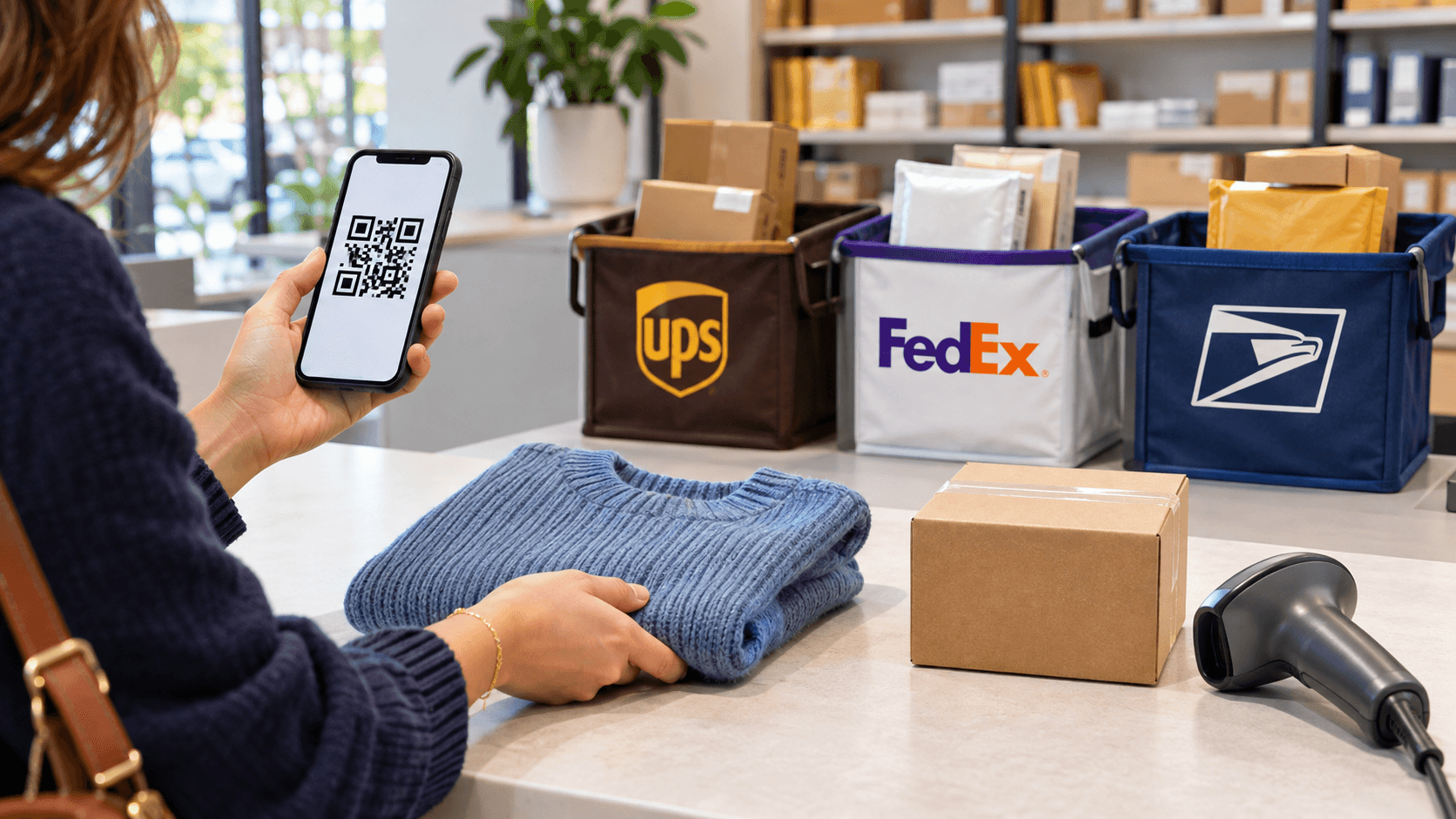
Among the dedicated consolidated box-free return networks compared here, UPS’s Happy Returns publishes the largest footprint: 10,000 Return Bar locations in the U.S., after an expansion UPS announced in April 2026, where a shopper hands over the item with no box and no label. FedEx Easy Returns, the FedEx equivalent, lists 4,000 participating locations. USPS offers a different kind of convenience: a prepaid return can be collected from the customer’s home during regular mail delivery, free. Which carrier makes returns easiest depends on the retailer’s returns program, the item and where the customer lives.
Returning something yourself? Start from the retailer’s returns page: box-free options only work if the retailer offers them, and the retailer’s portal gives you the QR code and the list of drop-off locations that accept it. FedEx publishes a finder for FedEx Easy Returns locations, and Happy Returns lists Return Bars on its site.
UPS vs FedEx vs USPS returns at a glance
| UPS: Happy Returns, consolidated Return Bar service | FedEx: Easy Returns | USPS: Returns | |
|---|---|---|---|
| Drop-off network for the service | 10,000 Return Bar locations, including 5,000+ The UPS Store locations | 4,000 FedEx Office, PackageHub and Kohl’s locations | Post Offices, collection boxes, and Package Pickup from the customer’s address |
| Box needed? | No | No | Packaging required for standard returns: a box or suitable mailer, packed and sealed by the customer |
| Label needed? | No: the shopper brings a QR code | No: just the QR code | A prepaid label, or a QR code printed free at Post Offices with Label Broker |
| How returns travel | Consolidated with other retailers’ returns to a regional Return Hub, then shipped in bulk to the retailer | Consolidated into one box with other unpackaged returns | Each package individually, as Ground Advantage Return (2 to 5 days), Priority Mail Return (2 to 3) or Priority Mail Express Return (1 to 3) |
| Item check at drop-off | Yes: every item is scanned and verified | Not stated | No |
| Best suited to | Retailers wanting the widest box-free reach and checks at drop-off | Soft goods in a poly bag, usually under 5 lb, U.S. only | Eligible mailable items within USPS weight, size and content restrictions, up to 70 lb on Ground Advantage Return, and customers who prefer home pickup |
| Merchant minimum | Not published | 50 packages average daily volume; mostly suited to about 12,000 returns a year or more | No minimum |
| Published pricing | Not published | Not published; described as low-priced | Published prices, charged per piece on labels scanned |
Sources: Happy Returns, box-free Return Bar network page; FedEx, FedEx Easy Returns and FedEx returns pages; USPS, Customer Returns, Label Broker and Schedule a Pickup pages; all read November 23, 2026. The Happy Returns figure is from UPS’s announcement of April 21, 2026. FedEx’s general business returns page still lists about 3,000 Easy Returns locations; we use the dedicated Easy Returns page. Network counts are for the returns service named, not each carrier’s total drop-off network.
Box-free, label-free and prepaid returns are different things
Three return experiences get described as “easy”, and they are not the same.
- Box-free. The customer hands over the item itself, and the location packs it. Happy Returns and FedEx Easy Returns work this way.
- Label-free, or printer-free. The customer shows a QR code and the location prints the label. That removes the printer, not the box. FedEx’s standard QR-code returns ask the customer to bring a sealed box, and USPS Label Broker prints the label free at participating Post Offices but asks the customer to pack and seal the package.
- Prepaid. The merchant puts a return label in the box or emails one. The customer still packs the item and drops it off, or, at USPS, leaves it for the carrier.
FedEx also describes QR-code returns at about 10,000 participating FedEx Office, FedEx Ship Center and Walgreens locations, where staff can offer packaging. That is a different program from Easy Returns, and the item is packed and shipped individually.
UPS Happy Returns vs FedEx Easy Returns
The Return Bar service and FedEx Easy Returns are the closest like-for-like comparison: both take items without a box or label and consolidate them. UPS agreed to buy Happy Returns from PayPal in October 2023. Return Bars include more than 5,000 The UPS Store locations as well as retailers such as Ulta Beauty and Staples, and in April 2026 UPS added more than 1,700 sites through authorized shipping outlets such as Annex Brands and PackageHub.
| Happy Returns, consolidated Return Bar service | FedEx Easy Returns | |
|---|---|---|
| At drop-off | Each item scanned and checked against the return | QR code scanned; item goes into consolidated shipment |
| Refund timing | Refund or exchange initiated once the return is approved at drop-off; high-risk returns held for audit | Not stated by FedEx |
| Transport | Consolidated across retailers to a regional Return Hub, sorted by retailer, palletized and shipped in bulk with advance notice | Unpackaged returns consolidated into one box; FedEx says you exchange speed for reduced costs |
| Integration | Its own portal, partner returns portals such as Loop, AfterShip and parcelLab, or an API | FedEx returns technology by API, or a third-party returns platform |
Sources: Happy Returns, box-free Return Bar network page; FedEx, FedEx Easy Returns; UPS, releases of October 25, 2023 and April 21, 2026. Read November 23, 2026.
Happy Returns’ advantage is reach and the check at the counter: the retailer knows what came back before the item arrives, and the shopper gets a refund or exchange started on the spot. FedEx Easy Returns is narrower by design. It is built for light soft goods, sets a volume minimum, and FedEx is explicit that consolidation trades speed for cost. For a retailer selling apparel at volume, both are candidates.
Items outside a consolidated program’s eligibility may still qualify for individually shipped returns. Happy Returns also offers non-consolidated drop-off for UPS clients: with “No Pack or Print”, the store associate packs the item and prints the label, and the packaging cost is billed to the merchant’s UPS account. Happy Returns lists limits for it, including a declared value under $1,000 and weight restrictions, and the UPS account must have non-consolidated returns enabled.
Where USPS fits
USPS’s strength is the packaged return and the customer who does not want to go anywhere. USPS Returns offers three services, Ground Advantage Return, Priority Mail Return and Priority Mail Express Return, each with $100 of insurance included. Labels are scan-based: the merchant is charged per piece for labels that are scanned, and there is no minimum return volume. A merchant without a printer workflow can have USPS print and deliver physical labels for $1.65 each.
For the customer, two features stand out. Label Broker lets them show a QR code at a participating Post Office counter or kiosk and have the label printed free. And a package with a prepaid USPS Returns label can be collected free during regular mail delivery, by scheduling a Package Pickup online. Neither UPS nor FedEx box-free service collects from home.
USPS has also begun describing box-free options. Its December 25, 2025 Postal Bulletin lists “Package Free Returns” among its Priority Mail Returns features, without setting out how they work or where. Treat that as program-specific and check with USPS before building a returns policy around it; the standard USPS return still expects a packed, sealed package.
How retailers should compare return costs
None of the box-free services publishes a price, and the transportation charge is only part of what a return costs. Compare the whole cost per completed return:
- Transportation. Consolidated returns travel in bulk, which is how the providers keep cost down; FedEx describes Easy Returns as low-priced. Individual labels are priced per package by weight and zone, the same way as outbound shipping.
- Packaging and handling. Box-free services pack the item for you; packaged returns put that cost on the customer or the merchant.
- Platform and integration. Returns portal fees, integration work and any per-return service fee.
- Processing time. Consolidation can add processing and transit time. Slower returns hold inventory out of stock for longer, which matters most for seasonal and fast-selling items.
- Inspection and fraud. An item checked at drop-off arrives with fewer surprises; an unchecked package has to be opened and graded at the warehouse.
- Customer contacts. A return that is confusing or slow to refund generates support contacts, which cost money even when the shipping is cheap.
Two other questions are worth answering from your own data. What share of your returns meets each provider’s product, weight and packaging requirements? And are returns a large enough share of your volume to count toward your outbound carrier relationship? Moving return labels between carriers changes the volume each carrier sees.
Merchant checklist
- Profile your returns: annual count, average daily volume, weight, and the share that would fit a poly bag.
- Map where your customers live against each network’s locations.
- Check whether your returns portal already integrates with Happy Returns or FedEx returns technology.
- Decide how fast you need items back, and whether consolidation’s extra time is acceptable.
- Keep a packaged-return option, usually prepaid USPS or carrier labels, for items the box-free services do not take.
- Price the options on total cost per completed return, including handling, processing time and support contacts.
When returns end up back at the sender for other reasons, our USPS return to origin guide explains who pays.
See what returns are costing you
Send us your outbound and return shipment data. We’ll use our proprietary ebb Logic™ software to analyze your shipping costs and identify where different return services warrant a closer comparison. Request a free analysis.
Frequently asked questions
Which carrier is leading on easy returns?
Among the consolidated box-free networks, UPS’s Happy Returns publishes the largest, 10,000 Return Bar locations, against 4,000 for FedEx Easy Returns. For customers who prefer home collection, USPS offers free scheduled pickup of eligible prepaid returns during regular mail delivery.
Is Happy Returns better than FedEx Easy Returns?
Its Return Bar service has more locations and checks each item at drop-off. FedEx Easy Returns is built for light soft goods under about 5 lb, has a volume minimum and trades speed for cost. Which is better depends on what you sell and where your customers are.
Does a return QR code mean I don’t need a box?
Not always. With Happy Returns and FedEx Easy Returns, no box is needed. With a standard FedEx QR-code return or USPS Label Broker, the QR code replaces the printer, and you still bring a packed, sealed package.
Is there a minimum volume for FedEx Easy Returns?
Yes. FedEx lists a minimum of 50 packages average daily volume and says the service mostly suits merchants with about 12,000 returns a year or more.
Is USPS return pickup free?
Yes, for eligible packages scheduled for pickup during regular mail delivery, including USPS Returns packages with a prepaid label. A pickup at a specific time costs extra.
Does free drop-off mean the retailer pays nothing?
No. The shopper does not pay at the counter, but the retailer pays for the return service, the transportation and the handling, under its agreement with the provider.
Sources
- Happy Returns, Box-free Return Bar network, and QR code returns for UPS customers, for non-consolidated drop-off, read November 23, 2026.
- UPS, UPS and Happy Returns Cement Position as Largest Box-Free, Label-Free Return Network with Expansion to 10,000 U.S. Locations, April 21, 2026.
- UPS, UPS to Acquire Happy Returns, a Leader in Reverse Logistics, October 25, 2023.
- FedEx, FedEx Easy Returns, returns for business and returns, read November 23, 2026.
- USPS, Customer Returns, Label Broker and Schedule a Pickup, read November 23, 2026.
- USPS, Postal Bulletin 22692, December 25, 2025, “USPS is Ready for the Returns Season”.